Insider Brief
- Deep Robotics deployed DR02 humanoid robots in Hangzhou’s Xihu District to test traffic direction, public guidance and other support functions under real-world conditions including heavy crowds, vehicle traffic and sustained rain.
- The IP66-rated DR02 uses environmental perception and motion control to navigate intersections, avoid pedestrians and vehicles, provide multilingual tourist assistance and identify behaviors including helmet violations, overloaded e-bikes and improper road crossings.
- Deep Robotics said the trials are testing whether humanoids can take on repetitive traffic and advisory duties while personnel focus on traffic organization, emergency response and enforcement, with data from the deployments being used to refine the robot for additional public-service applications.
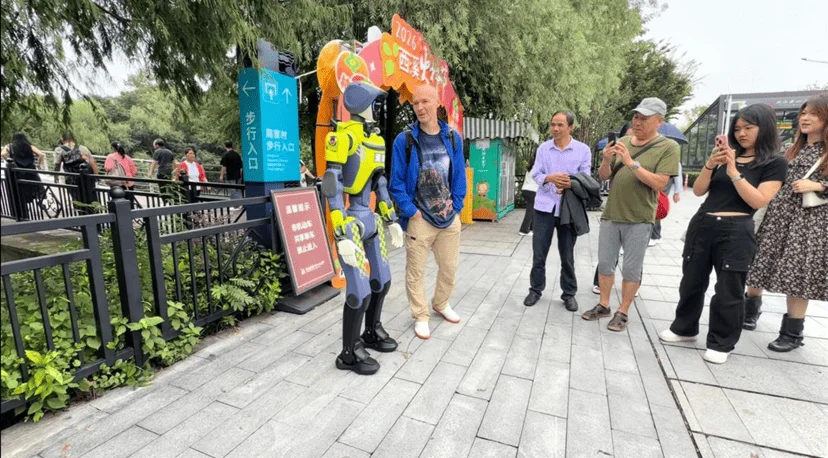
Deep Robotics has deployed a group of its DR02 humanoid robots in China’s Hangzhou’s Xihu District to test whether the machines can assist with real traffic conditions rather than controlled environments.
According to Deep Robotics, the field trials took place in early October during periods of heavy visitor and vehicle traffic as well as sustained rain at locations including Xixi National Wetland Park and intersections along Zheda Road and West Wenyi Road in Lingyin Subdistrict.
Deep Robotics said the trials were meant to see whether humanoids could take on repetitive traffic and guidance work, freeing staff to focus on jobs that need more human judgment, such as managing traffic, handling emergencies and enforcing rules.
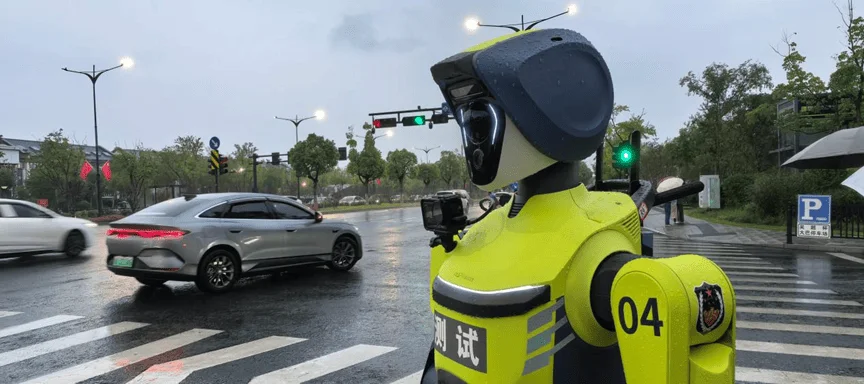
At intersections, the robots directed traffic, helped maintain order and assisted visitors. Since the DR02 has IP66 protection against rain and dust, the company said it also used the wet weather to test how well it could stay on duty outdoors.
The robot uses onboard sensing and motion controls to move around intersections on its own, avoid people and vehicles, and adjust its position and hand signals as traffic conditions change, according to Deep Robotics. In busy tourist areas, Deep Robotics also tested DR02 as a multilingual guide. The robot can answer questions about routes, transportation and nearby attractions, while also giving visitors traffic-safety reminders.
Peak-hour trials focused on identifying common traffic violations and unsafe behavior. Deep Robotics said the robot’s visual-perception systems can detect:
- E-bike riders without safety helmets.
- Overloaded e-bikes.
- Pedestrians crossing designated lines.
- Vehicles stopping beyond marked lines.
The robot can then provide safety reminders through voice prompts, according to the company.
The company also used the tests to collect data on DR02’s abilities and the results will be used to further refine the robot for traffic-support applications. It plans to continue testing humanoid robots in the real world as it develops their environmental perception, motion control, interaction and task-execution capabilities.
Deep Robotics said it is exploring additional uses for the technology in traffic management, public services and other urban operations.