Insider Brief
- Physical Intelligence has launched a beta version of its Pi API, giving robotics developers hosted access to its latest foundation models for fine-tuning and inference.
- Developers can upload robot data, fine-tune a Pi model on company-managed compute and deploy it through a hosted inference gateway, allowing teams to iterate on tasks without building the full machine-learning infrastructure themselves.
- Early users span applications including autonomous heavy equipment, food preparation, manufacturing and dual-arm robotics, with Physical Intelligence using developer feedback to guide future model and API releases.
Physical Intelligence has launched a beta version of its Pi API, giving robotics developers access to its latest foundation models for fine-tuning and inference without having to manage the underlying machine-learning infrastructure themselves.
According to the company, developers can upload robot data, fine-tune a Pi model using compute managed by Physical Intelligence and then run the resulting model through a hosted inference gateway. The service is designed to reduce the engineering work needed to adapt general-purpose robotics models to specific machines, tasks and operating environments.
Physical Intelligence develops general-purpose robotic foundation models including π0 and π0.5. The models are intended to provide a base of physical knowledge that can then be adapted with additional training data for individual applications.
The company said the latest model available through the API improves data efficiency during fine-tuning and will be updated as newer models become available.
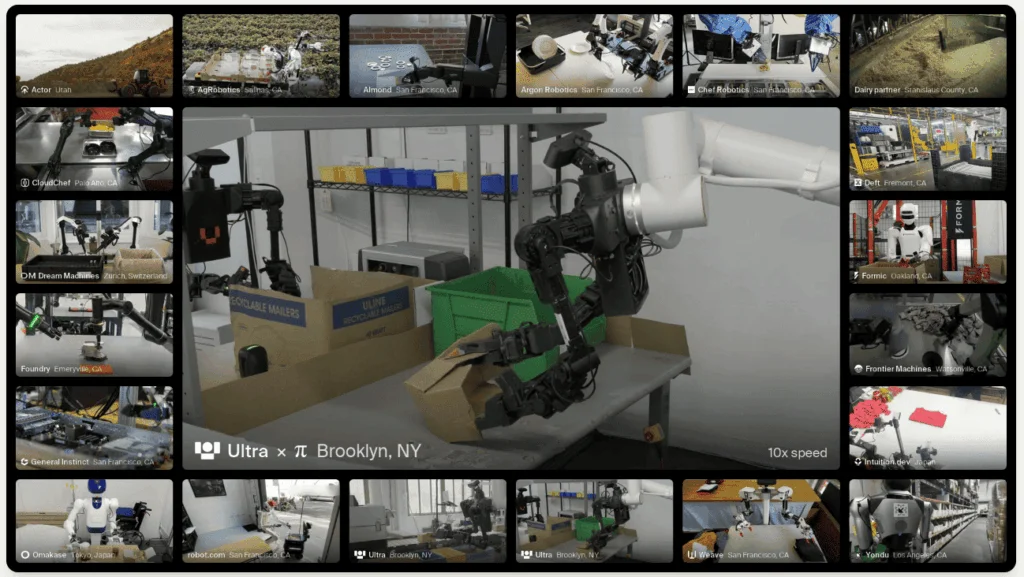
Physical Intelligence has been testing the system with companies working across several types of robotics. Early examples include autonomous heavy equipment, food preparation, manufacturing and dual-arm robots.
The company highlighted a common development cycle among those users:
- Collect demonstrations: Gather examples of the task from robots or operators.
- Fine-tune the model: Train a Pi model on the application-specific data.
- Test on hardware: Run the model on the robot in its operating environment.
- Study failures: Use mistakes and weak performance to determine what additional data is needed.
- Repeat: Retrain and test until performance improves.
Physical Intelligence said it built the API so developers can run that process themselves rather than relying on the company to perform each training iteration.
Among the early users, Almond used the API to train its Axol dual-arm robot to deburr spacers used in the robot’s own assembly. The company reached that result after four days of iteration, according to Physical Intelligence.
Other early participants include Actor, Argon Robotics, Chef Robotics, Deft, Dream Machines, Formic Robotics, Foundry, Frontier Machines, General Instinct, Omakase and Yondu.
Most of the deployments shown by Physical Intelligence used cloud-hosted inference through the API. The company said those tests also exposed limitations, including network-connectivity problems in some environments.
Physical Intelligence indicated the beta is intended both to make its models easier for outside developers to use and to gather information about how the models perform across different robots and tasks. Feedback from developers will be used to guide future model and API releases.
The company is accepting applications from developers interested in participating in the beta.