Insider Brief
- Neura Robotics and NXAI are partnering to develop a memory system for cognitive robots that combines Neura’s physical AI stack with NXAI’s xLSTM architecture to help robots maintain context across multi-step tasks and draw on past experience.
- The work will build on Neura’s Neuron AI foundation model and target both working memory for tracking the immediate state of a task and episodic memory for using prior experience when similar situations arise again.
- NXAI’s xLSTM-based model will be added to the Neuraverse platform alongside Neuron AI, where companies will be able to fine-tune it, test it in Neura Gyms and deploy it on compatible robots while retaining control over their own process knowledge, data and skills.
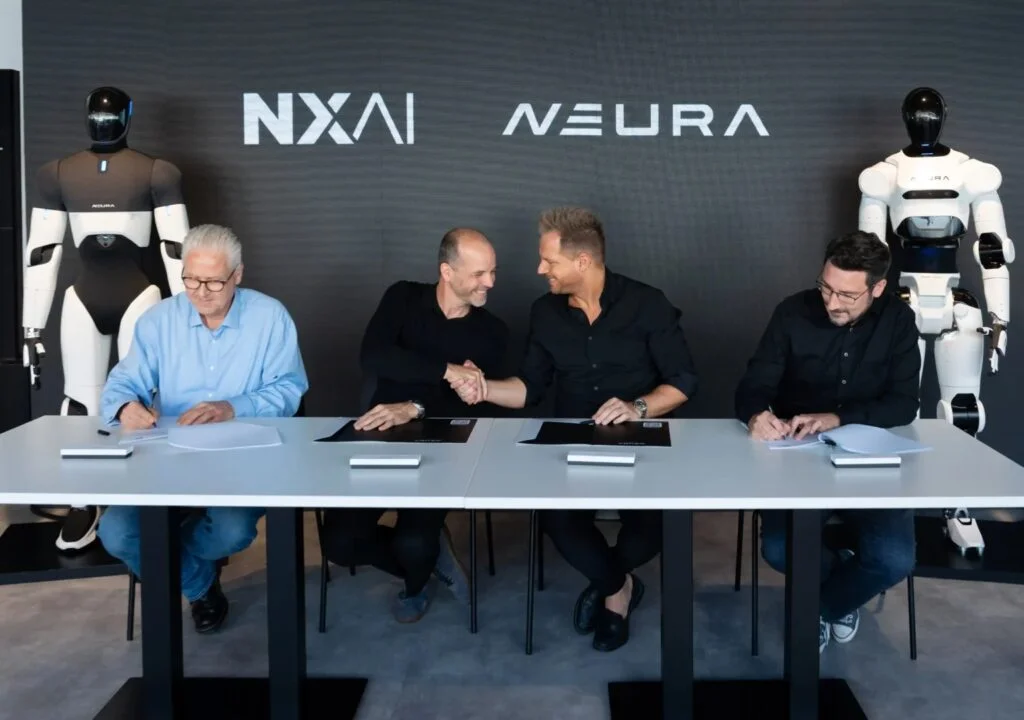
Neura Robotics and NXAI are partnering to develop a memory system for cognitive robots, combining Neura’s physical AI platform with NXAI’s xLSTM architecture to help robots track multi-step tasks and draw on past experience.
According to the Germany-based Neura, the work will build on Neuron AI, its multimodal foundation model for physical AI that combines 3D vision, touch, audio, robot state and language with memory capabilities. Under the partnership, Neura will integrate its physical AI stack with xLSTM, a recurrent AI architecture developed by NXAI under founder professor Sepp Hochreiter. NXAI, which is based in Austria, said xLSTM is designed to efficiently maintain and update information across long sequences, allowing a robot to retain relevant information as a task progresses.
Physical AI Memory
The companies noted robot memory is more complicated than that of an AI chatbot that handles one request at a time. Working memory helps a robot keep track of the immediate state of a task, such as whether a component has already been inserted, a door is open or a machine has been started. Beyond xthat even is episodic memory that lets robots use experience from previous attempts when they encounter similar situations again.
That capability means robots can operate through continuous cycles of sensing, decision-making and action rather than handling isolated requests. Neura and NXAI said the goal is for robots to maintain context across many steps and eventually build on experience accumulated over time.
“A robot that genuinely helps in everyday life and industry must be able to remember,” Neura founder and CEO David Reger said in the announcement. “With Neuron AI, we have the foundation. With the Neuraverse, we are building the platform through which strong AI approaches from others can find their way into robots. With Sepp Hochreiter and NXAI, we are now building out that memory together. Two European strengths, one goal: Physical AI from Europe, together for the world.”
A Place in the Neuraverse
The planned integration will add NXAI’s xLSTM-based model to the Neuraverse platform alongside Neura’s Neuron AI, giving companies another model option within the same training and deployment environment. Companies will be able to fine-tune the NXAI model for their own tasks using the Neuraverse toolchain, test it in Neura Gyms and deploy it on compatible robots.
Neuron AI will continue to be developed independently, while Neura and NXAI will also conduct joint research. Companies using the platform will retain control over their process knowledge and decide whether to share data and robot skills.
Companies using Neuraverse are expected to be able to:
Fine-tune models: Adapt the NXAI model to specific tasks using the Neuraverse toolchain.
Test robot behavior: Evaluate models and applications in Neura Gyms, which provide real-world robot training environments.
Deploy models: Move trained models onto compatible robots through the same platform used for training and application development.
“Memory and experience are what allow robots to solve tasks reliably across many steps,” added Hochreiter. “xLSTM is built for that: fast, memory-efficient and capable of holding state across long sequences. Together with Neura, we are bringing that strength into Physical AI, from Europe, for the world.”