Insider Brief
- Neura Robotics unveiled 4NE1 Gen 4, a 20% lighter humanoid designed for series production, as it and the Technical University of Munich opened a €17M RoboGym for developing physical AI skills.
- The new humanoid runs Neura’s Neuron AI model and adds upgraded hands and Smart Limbs, while the company said it is already being used at the Munich training center.
- The 2,300-square-meter RoboGym brings together companies from more than 10 industries and combines real-world robot data, human demonstrations and simulation to train physical AI systems.
Neura Robotics has unveiled 4NE1 Gen 4, a lighter version of its humanoid designed for series production, as the company and the Technical University of Munich opened a €17 million robot training center aimed at developing physical AI skills for industrial use.
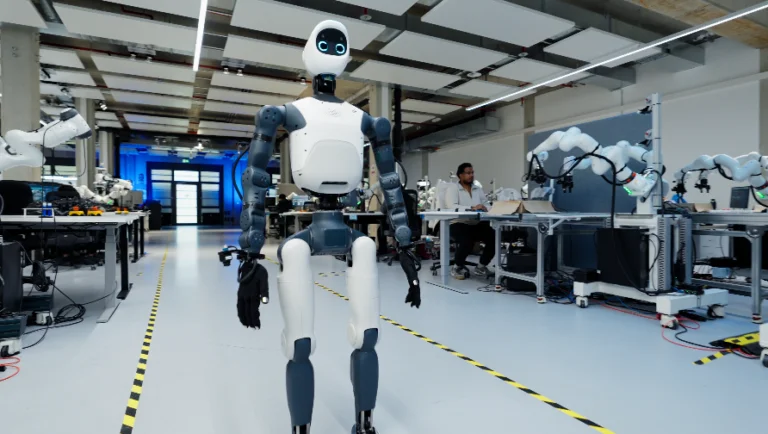
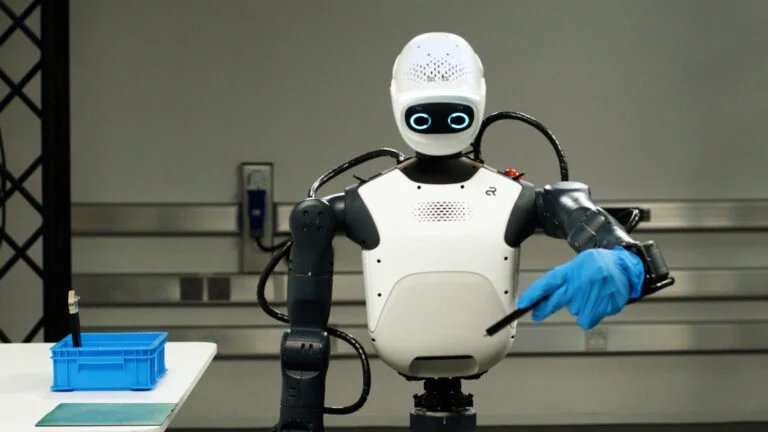
According to Neura, the new humanoid is 20% lighter than its predecessor and has a slimmer body, upgraded hands and what Neura calls Smart Limbs, which place reflex-like control directly in the robot’s limbs. It runs Neuron AI, the company’s Perception-Language-Action model for physical AI.
Neura said the model uses vision, touch, force, sound and information about the robot’s own state to translate perception into movement for tasks that require robots to determine whether a physical action has been completed correctly, such as recognizing when a fastener has clicked into place.
The company noted the humanoid’s upgraded hands provide more precise gripping, while the Smart Limbs allow individual limbs to respond independently to changes in the environment. The robot also has a slimmer design and black textile outer skin.
4NE1 Gen 4, used at Nvidia GTC Berlin to showcase which robots are ready for the TUM RoboGym near Munich Airport where it already in use, is being prepared for series production, Neura said.
“Our companies hold knowledge that has been built up over generations,” Neura founder and CEO David Reger said in the announcement. “People know how to work materials, assemble components and master difficult processes. This knowledge is one of our greatest strengths in the age of Physical AI. With TUM, we are building a powerhouse for physical capabilities, where this knowledge becomes the foundation for new possibilities.
Training Robots on Real-World Tasks
According to Neura, TUM RoboGym is designed to provide the data and practical experience used to train systems including 4NE1 Gen 4.
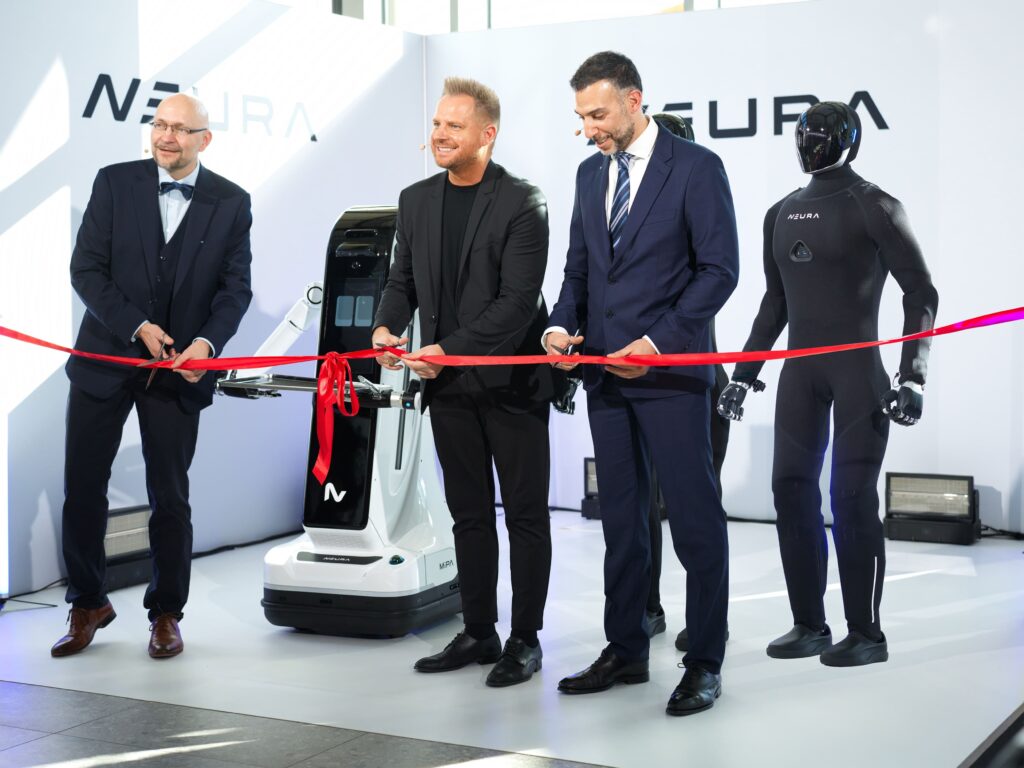
Neura and TUM opened the 2,300-square-meter facility at LabCampus near Munich Airport in partnership with TUM’s Munich Institute of Robotics and Machine Intelligence. The joint initiative is initially planned for three years, with Neura contributing about €11 million of the roughly €17 million total investment.
“The TUM RoboGym robotics center is unique in Germany and Europe,” said professor Thomas Hofmann, President of TUM. “By collaborating with a robot manufacturer based in Germany, we are also sending a clear signal for Germany as an industrial location in geopolitically uncertain times.”
Companies from more than 10 industries are already participating, including automotive, pharmaceuticals, medical technology, packaging, logistics, agriculture and care, according to Neura.
Training began in September and includes tasks such as handling cardboard boxes, filling bottles and loading and unloading wooden components. Companies can use the center to test potential applications, determine what robot skills are required and evaluate different robot systems before expanding deployments in their own operations.
The facility includes humanoid robots, mobile assistance robots such as Neura’s MiPA and cognitive robot arms including the company’s Maira platform.
Munich is expected to become the first location in a broader international network of Neura Gyms.
Building Physical AI Training Data
The RoboGym brings together researchers, students and companies so industrial tasks can be tested under practical conditions while also generating new research questions for TUM and Neura.
The RoboGym combines three approaches to generating data for physical AI development.
Real-world robot data: Robots perform tasks while their sensors record movements, physical contact and the outcomes of their actions.
Human demonstrations: Workers demonstrate tasks using sensor-equipped suits, motion capture and teleoperation systems that convert human movements and interactions into training data.
Simulation: Virtual environments generate additional variations in tasks and conditions before the resulting skills are tested on physical robots.
Neura said its Neuraverse platform connects that training infrastructure with the company’s software and AI tools. Data generated by robots, human demonstrations and simulation can be structured and processed for physical AI research and model development.
Neuron AI is trained using those same types of data. Through Neuraverse, Neura said skills learned by one connected robot can also be made available to other robots using the platform.