Insider Brief
- A new MIT-backed study using U.S. Census Bureau data reveals that AI adoption in manufacturing leads to early productivity setbacks before delivering long-term growth gains.
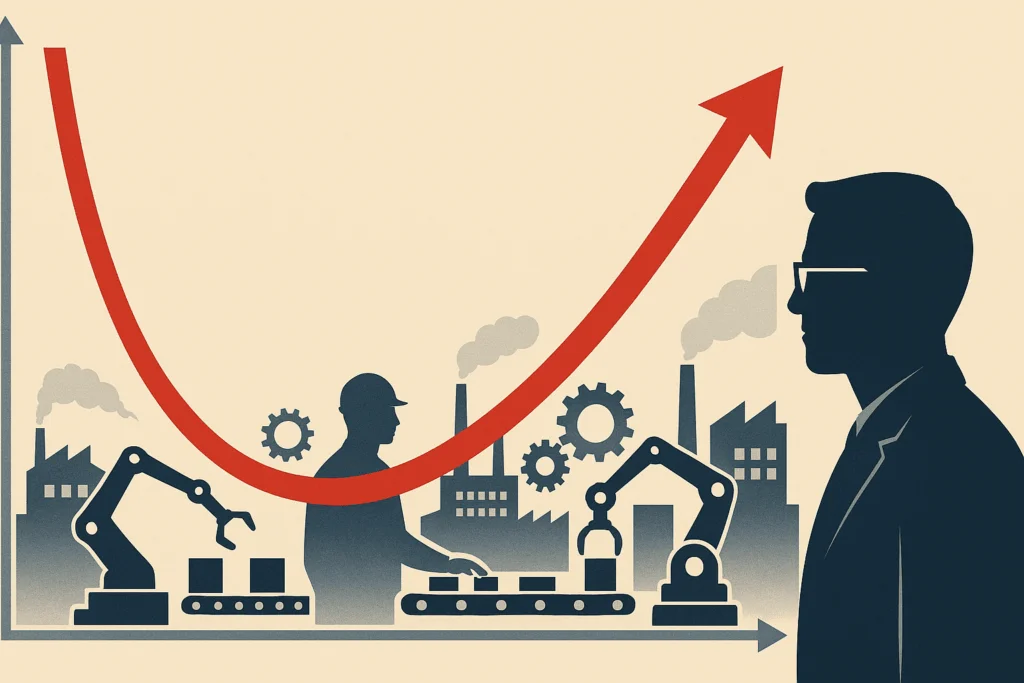
- Researchers found a consistent “J-curve” trajectory: initial performance declines of up to 60 percentage points followed by improvements in productivity, revenue, and market share.
- The effect is most pronounced in older firms with legacy systems, while younger, digitally mature companies recover faster and benefit sooner from AI integration.
The U.S. manufacturing sector is seeing early setbacks but long-term gains from artificial intelligence adoption, according to a new study backed by data from the U.S. Census Bureau and led by researchers at MIT.
The research, funded in part by MIT’s Initiative on the Digital Economy, finds that firms introducing AI tools often suffer an initial decline in productivity, output, and other performance indicators before rebounding with stronger growth. This pattern forms what researchers call a “J-curve,” where disruption precedes benefit. Despite the early downturn, the study identifies measurable long-term improvements in productivity, revenue, and employment, according to MIT.
“AI isn’t plug-and-play,” noted University of Toronto professor Kristina McElheran, a digital fellow at the MIT Initiative on the Digital Economy and one of the lead authors of the new paper “The Rise of Industrial AI in America: Microfoundations of the Productivity J-Curve(s).” “It requires systemic change, and that process introduces friction, particularly for established firms.”
The study draws on data from tens of thousands of U.S. manufacturing firms in 2017 and 2021, sourced from official Census Bureau surveys. Researchers from the University of Toronto, University of Colorado Boulder, Stanford University, and the U.S. Census Bureau collaborated on the analysis and MIT pointed out researchers found that the J-curve effect was most pronounced in older and more established companies, where legacy systems and entrenched management practices created friction in the transition.
“Old firms actually saw declines in the use of structured management practices after adopting AI,” McElheran said. “And that alone accounted for nearly one-third of their productivity losses.”
In contrast, younger firms that had already integrated digital tools or data infrastructure showed fewer short-term losses and rebounded faster.
Across the board, AI adoption initially reduced productivity by an average of 1.33 percentage points, even after controlling for firm size, capital stock, and IT maturity. When correcting for selection bias—the fact that early adopters may have been more optimistic or better resourced—the short-term losses grew to as much as 60 percentage points.
Despite the early turbulence, the study found that AI-adopting firms eventually outpaced their peers in both productivity and market share. The strongest gains were concentrated in digitally mature firms that were better equipped to scale AI applications and reallocate resources strategically, researchers indicated. The study also found investments in automation technologies, such as industrial robotics, helped accelerate the recovery.
The findings offer a more nuanced view of AI’s economic impact. While public discussions often focus on the transformative potential of AI, the study shows that its integration into traditional industries involves costly and disruptive transitions. The results also help explain why AI-driven productivity gains at the macroeconomic level have been slow to appear, despite widespread investment and optimism.
The researchers caution that their analysis is limited by the four-year interval between the two survey waves, which may not capture more granular changes or sector-specific dynamics. In addition, newer forms of AI, such as generative models, were not a focus of the study and may follow different adoption patterns.
“Taken together, our findings highlight AI’s dual role as a transformative technology and catalyst for short-run organizational disruption, echoing patterns familiar to scholars of technological change,” the researchers pointed out.