Insider Brief
- Hesai has launched Kosmo, a 3D world data system that combines its Kosmo One spatial camera and Kosmo World cloud platform to turn real environments into digital spaces for robot training, world models and other spatial applications.
- Hesai said a single operator can scan a typical 100-square-meter indoor space in about 15 minutes, while Kosmo can generate simulation-ready environments with 3D Gaussian Splatting, mesh and depth data, semantic segmentation and generative reconstruction.
- The company is also expanding into robotic actuation, with more than 10,000 actuation modules shipped by the end of the second quarter of 2026 and six-figure shipments expected in 2027, while new Kosmo partnerships include Galbot and Dexmal.
Hesai has launched Kosmo, a 3D world data system designed to capture real environments and convert them into digital spaces for robot training, world models and other spatial applications.
“Physical AI needs infrastructure that lets it understand the real world and act within it,” said co-founder and CEO Yifan “David” Li said in the announcement. “Our 3D world data engine and robotic motion engine address both needs, building directly on Hesai’s strengths to create our second growth driver. Over the past decade, we have enabled machines to see the world. Over the next decade, we will enable robots to understand and change it.”
How Kosmo Works
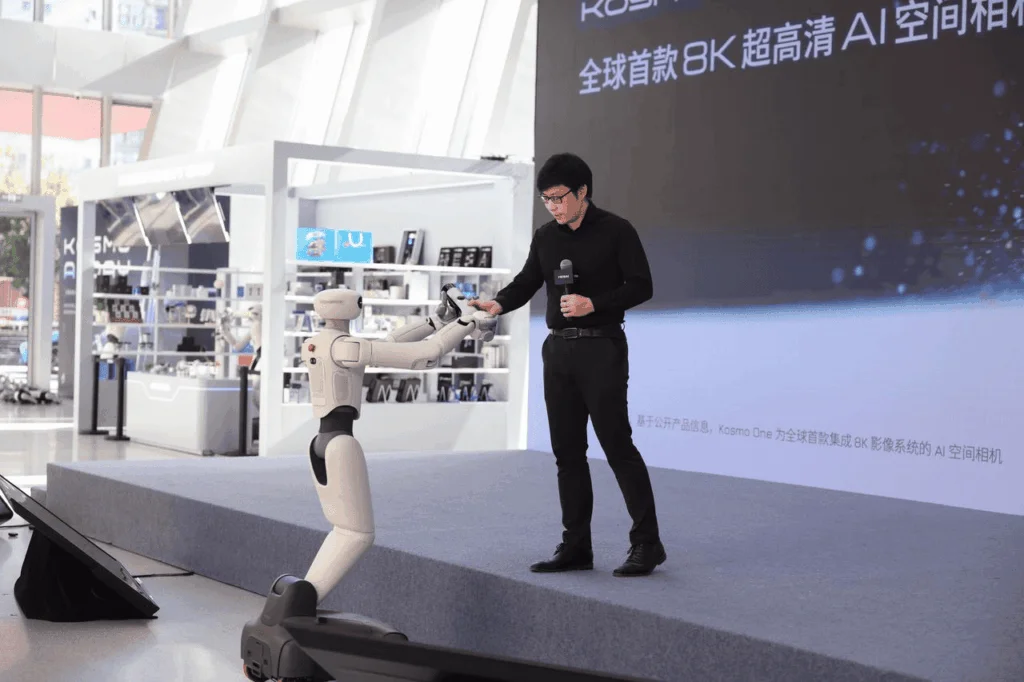
According to the China-based Hesai, Kosmo combines the company’s Kosmo One spatial camera with its cloud-based Kosmo World platform. The system captures geometry, color, texture and camera position, then reconstructs the information into 3D environments that can be used in simulation and AI training.
Kosmo One combines lidar, a one-inch imaging sensor and an inertial measurement unit, with synchronization across the sensors. Hesai said the camera supports 8K capture, though exported files are limited to 6K, and uses 3D Gaussian Splatting to reconstruct environments with millimeter-level geometric accuracy.
A single operator can scan a typical 100-square-meter indoor space in about 15 minutes, according to Hesai. The company said Kosmo World can then generate 3D models at speeds of up to five times comparable reconstruction products under similar conditions.
The company noted the launch also expands its physical AI business beyond lidar, where deliveries have doubled for nine consecutive years. The company is developing robotic actuation hardware used in Sharpa’s Wave dexterous hand and said cumulative shipments of its actuation modules exceeded 10,000 units by the end of the second quarter of 2026. Hesai expects shipments to reach six figures in 2027.
Training Physical AI
For robotics, Kosmo World converts captured spaces into simulation-ready environments. Its main functions include:
- Generating 3D Gaussian Splatting, mesh and depth data from the same reconstruction.
- Identifying individual objects through semantic segmentation.
- Filling unscanned areas and reconstructing materials and textures using generative AI.
- Adjusting views to match the camera characteristics of individual robots.
Hesai pointed out its demonstration of the system at a Dairy Queen store, where it said a 3D training environment that previously required about 300 hours of manual modeling was created through scanning and reconstruction in 15 minutes. The company said a Sharpa robot trained with the environment reached a 99% task success rate and reduced failures to one-tenth of their previous level.
World Models
Kosmo is also designed world-model development. Hesai said a single captured environment can be used to generate more than 10,000 training trajectories, providing more than 100 times the amount of training data for the same cost compared with collecting individual real-world robot trajectories.
Hesai announced partnerships with embodied AI companies Galbot and Dexmal as part of the launch. The company is also integrating Kosmo with Nvidia Isaac Sim and Isaac Lab, Unreal Engine, Pixar’s RenderMan and Houdini.
Beyond Robotics
Outside robotics, Hesai is targeting film production, cultural heritage and location services. The company said Kosmo can shorten the creation of some large digital sets and has worked with Amap to add reconstructed locations to its Flying Street View feature.