Insider Brief
- Icon has raised $200 million in Series D funding co-led by Baillie Gifford and funds managed by BlackRock to expand manufacturing and deployment of its robotic construction systems.
- The company plans to use the financing to scale its Titan multi-story print system, open a large R&D facility in Austin and expand across Texas, Florida, Washington, D.C., and other U.S. markets.
- Icon said it is on pace for 4x revenue growth in 2026, has completed more than 270 3D-printed buildings and is targeting a construction market shaped by a U.S. housing shortage and an aging workforce.
Icon has raised $200 million in Series D financing to expand production and deployment of its robotic construction systems, including the commercial rollout of its Titan platform.
According to Icon, Baillie Gifford and funds managed by BlackRock co-led the round, with participation from Capital Factory, CAZ Investments, Moderne Ventures, Moonshots Capital, Norwest, Overmatch, The Syndicate and Tiger Global.
The Austin, Texas-based company said it plans to use the funding to manufacture and deploy more robotic construction systems, open a large research and development facility in Austin and continue work on its Titan and Olympus technologies. It also plans to expand operations in Texas, Florida, Washington, D.C., and other U.S. markets.
Co-founder and CEO Jason Ballard said Icon’s decade of work has shown that construction automation has moved beyond an idea, with the company now pointing to completed projects, commercial deployments and customer demand as evidence the technology is gaining traction.
“Construction automation has crossed from potential into proven reality,” Ballard said. “This round puts that reality in builders’ hands: more Titan systems deployed across the country, deeper capability in housing, commercial, and defense, and continued work on the technology that will one day build humanity’s first structures beyond Earth. I believe we can imagine an end to the global housing crisis in our lifetime. We are grateful to the partners, builders, and investors who believed in this mission long enough to see it arrive.”
Icon said it is on pace to generate four times as much revenue in 2026 as it did last year, though the company did not disclose revenue figures. It has completed more than 270 homes and other structures across five states and two countries.
Titan
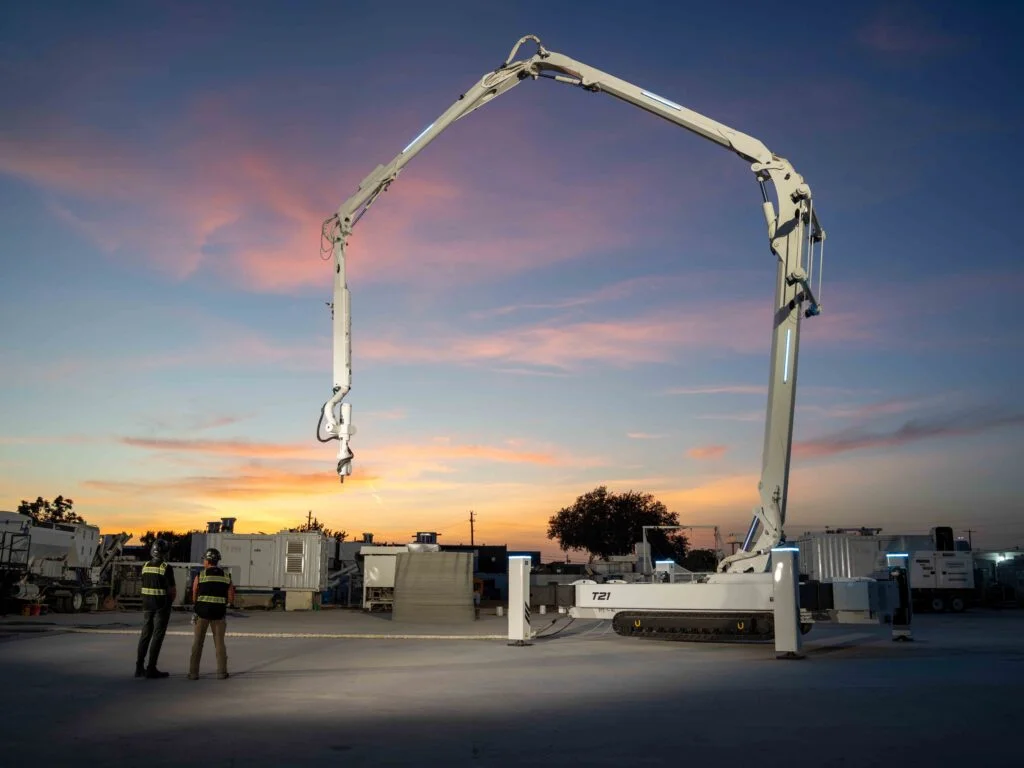
The new financing will support production of Titan at Icon’s Austin factory. Titan is a multi-story robotic construction system that uses 3D printing to build structural elements of buildings. Icon said the system is designed to reduce construction of an average home by six weeks and cut costs by 40% compared with the national average.
The system uses FormCrete, Icon’s proprietary 3D-printing material. The company said walls built with the material are rated to withstand winds above 175 mph and provide a fire rating of more than two hours.
Icon’s Structure
Icon organizes its operations around three main businesses:
- Build: Residential, commercial and hospitality construction using the company’s robotic systems and materials.
- Tech: Robotics, software, building materials and design tools used across its construction platform.
- Prime: Defense and space projects, including military infrastructure and construction technology intended for use beyond Earth.
Icon has used its systems for residential construction projects including Wolf Ranch in Georgetown, Texas, developed with Lennar, as well as homes at Community First! Village in Austin.
Icon Prime
The company has also expanded into military construction. In January, Icon began work on 10 barracks at Fort Bliss using additive manufacturing, which the company said is its largest military deployment to date. Icon said the structures are the first additively manufactured buildings to meet the Pentagon’s Unified Facilities Criteria.
Icon Prime has received more than $370 million in government contracts, according to the company. The division is also continuing work with NASA on Project Olympus, which is developing construction systems intended for use on the Moon.
Icon estimates the construction market at $16 trillion globally, while pointing to labor and housing shortages in the U.S. as drivers for automation. The company said the country is roughly 4 million homes short of demand, just 10% of construction workers are under 25 and 41% of the workforce is expected to retire by 2031.