Insider Brief
- Google DeepMind introduced Gemini Robotics 2, a three-model AI system designed to give robots whole-body control, greater dexterity, multi-step reasoning and the ability to collaborate with other robots.
- Tests showed stronger performance with two-finger grippers than multifinger hands, while Apollo 2 demonstrated full-body tasks including walking, bending and placing objects on shelves.
- Gemini Robotics On-Device 2 can adapt to new two-arm robot designs with fewer than 200 examples, while the ASIMOV-Agentic benchmark tests whether robots can reject unsafe actions and request human help.
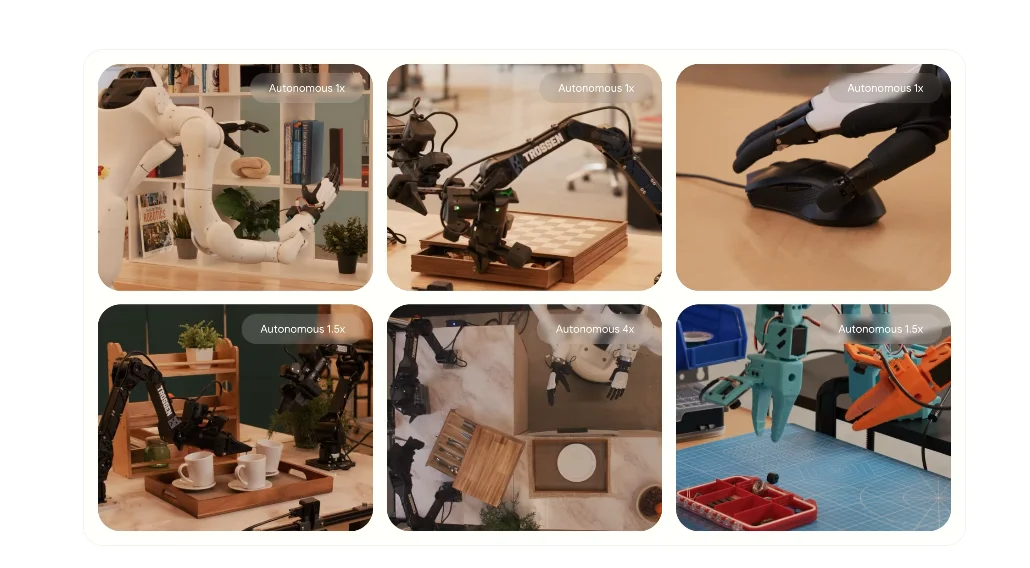
Google DeepMind has introduced Gemini Robotics 2, a family of AI models designed to give robots whole-body control, finer manipulation and the ability to work together on complex tasks.
The release is aimed at moving robots beyond narrow, preprogrammed routines. Google DeepMind said the new system can interpret spoken or written instructions, plan a sequence of actions and translate those plans into movement across different robot bodies.
The family includes three models:
Gemini Robotics 2 is a vision-language-action model that converts visual and language input into motor commands.
Gemini Robotics ER 2 serves as the reasoning layer, helping robots understand a scene, plan multi-step tasks and communicate with people.
Gemini Robotics On-Device 2 is designed to run locally on robot hardware, reducing dependence on internet connections and remote computing.
Whole-Body Control
While earlier Gemini robotics models focused mainly on upper-body and tabletop tasks, the new system can control an entire humanoid, including walking, bending, reaching and handling objects, Google DeepMind noted.
In one demonstration, an Apptronik Apollo 2 humanoid was asked to place a watering can in a green bin on a lower shelf. The robot walked to the object, picked it up, moved to the shelving area and placed it in the specified location. Video of the technology in action can be found here.
Performance remains uneven. Tests with Apollo 2 showed a 68.4% success rate when picking up objects from a table, 45.7% from the floor and 76.3% from a shelf. Google DeepMind also said the robot movement still needs to become faster and more reliable.
Hands and Grippers
Gemini Robotics 2 can also operate different types of robot hands and grippers. On Apollo 2, it controlled a five-fingered SharpaWave hand with 22 degrees of freedom, meaning 22 independently controlled movements.
The robot completed tasks including tying a trash bag, sealing a zip-close bag and handling a light bulb. It unscrewed the bulb successfully 92% of the time but achieved only 36% when screwing it in. Success rates were 44% for tying a trash bag, 40% for sealing a bag and 32% for using a dustpan.
Google DeepMind reported that results were stronger with two-finger grippers on a Franka Duo robot. The system scored 74.2% on general pick-and-place work, 78.9% on tool kitting and 89.6% on precise insertion tasks.
A video demonstrating the Gemini Robotics 2 manipulation can be found here.
Reasoning and Teamwork
Gemini Robotics ER 2 acts as the high-level brain. It observes the environment, breaks a task into steps, coordinates with the action model and tracks progress. Google DeepMind said it can manage tasks lasting several minutes and involving hundreds of decisions, while adjusting when an action fails.
“In this update, we are enabling robots to more reliably execute longer task sequences, lasting several minutes and involving hundreds of decisions,” the company noted in the announcement. “Gemini Robotics ER 2 now understands when tasks begin and end, and can pinpoint the moment key events occur, marking a step change in progress understanding.”
The update also introduces multi-robot collaboration, allowing different machines to divide a workflow based on their capabilities.
Running Directly on Robots
Local processing is important in settings where internet service is unavailable, unreliable or too slow for real-time movement.
Google DeepMind said Gemini Robotics On-Device 2 is optimized to run locally on robots, reducing reliance on internet connectivity and avoiding network delays. The model can adapt to new two-arm robot designs with fewer than 200 examples and several hours of training, including platforms with different shapes, sensors and ranges of motion.
Safety
Google DeepMind also introduced a safety benchmark called ASIMOV-Agentic. It tests whether robots can reject unsafe actions, recognize uncertainty and request human help. The company said Gemini Robotics ER 2 can better detect nearby people and stop a robot when someone approaches too closely during operation.
The company said Gemini Robotics ER 2 performs better than its earlier models at following safety limits and recognizing when people are nearby. The system can trigger safety procedures and bring a robot to a stop when someone moves too close.
Google DeepMind described those capabilities as part of a larger safety system combining conventional mechanical safeguards with controls built into the AI models.
Image credit: Gemini Robotics