
Insider Brief
- Pony.ai and Verne have begun fully driverless robotaxi test rides with passengers on public roads in Zagreb, removing the onboard safety operator from a service launched earlier this year.
- The tests cover a 22-kilometer route linking Verne’s headquarters and a major business district with Zagreb airport, using Pony.ai’s seventh-generation Level 4 robotaxi with NVIDIA DRIVE AGX and 360-degree sensor coverage.
- Pony.ai said its overseas deployment pipeline now exceeds 4,000 robotaxis, including plans with Uber for more than 2,000 vehicles across Europe, as it targets a global fleet of more than 3,500 robotaxis by the end of 2026.
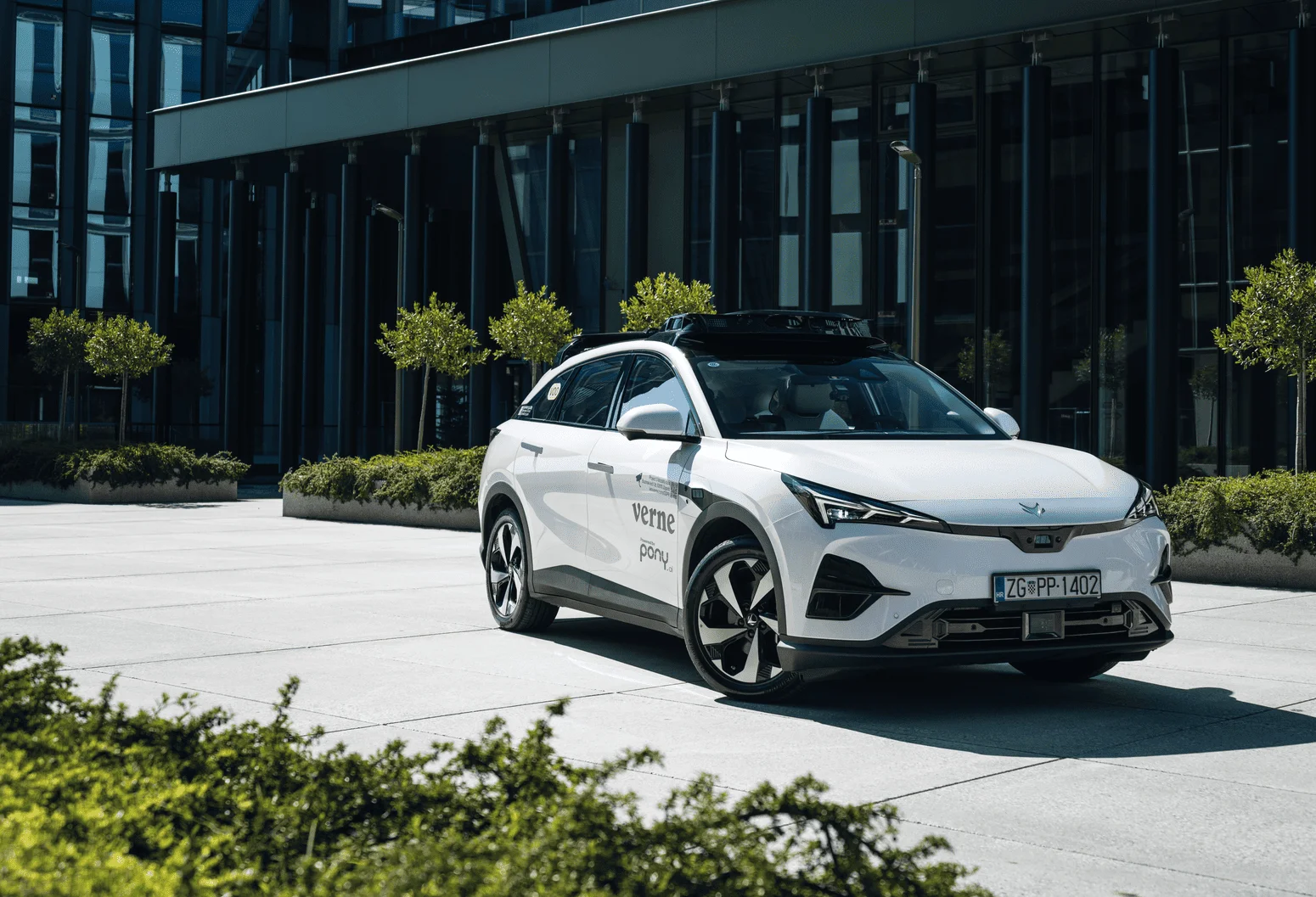
Pony.ai and Verne have begun fully driverless robotaxi test rides with passengers on public roads in Croatia.
According to the Chinese company, the tests are taking place along a 22-kilometer route connecting Verne’s headquarters and a major Zagreb business district with Franjo Tuđman Airport Zagreb. The companies plan to expand the driverless routes over the next several months with the goal of eventually covering the service’s full operating area in the Croatian capital.
Pony.ai described the passenger tests as a European first, coming just over five months after Pony.ai, Verne and Uber announced a partnership to launch a commercial robotaxi service in Europe. Under the joint deployment model, Pony.ai supplies the autonomous driving technology, Verne operates the service and manages the local deployment, and Uber connects riders to the robotaxis through its platform.
Since Verne launched the service in early April, its fleet has traveled more than 200,000 kilometers and completed several thousand customer rides, Pony.ai said. The company reported an average passenger rating of 4.7 out of 5.
Those operations initially included an autonomous-vehicle operator inside the vehicle. The latest tests remove that operator, allowing passengers to travel with no human driver onboard.
Seventh-Generation Robotaxi
The Zagreb tests, conducted under Croatian regulations and approvals, use Pony.ai’s seventh-generation robotaxi equipped with the company’s Level 4 autonomous-driving system. Level 4 systems are designed to operate without human driving within defined conditions and operating areas.
The vehicle uses a Pony.ai-developed controller built on Nvidia DRIVE AGX and running the safety-certified DriveOS operating system.
Pony.ai said the robotaxi includes 360-degree sensor coverage along with redundant systems designed to keep the vehicle operating if individual components fail. The architecture has previously been used in the company’s fully driverless commercial operations in China, where it currently operates fully driverless commercial services in four major cities. The company said its autonomous vehicles have accumulated more than 100 million kilometers of driving worldwide, including more than 40 million kilometers without a driver onboard.
International Expansion
The Croatia deployment is part of Pony.ai’s strategy to expand its robotaxi operations outside China through partnerships that combine autonomous-driving technology, local fleet operations and access to riders. Pony.ai said the structure can vary by market, allowing it to work with different local partners while reducing the capital required to enter new regions.
The company said recent partnerships have expanded its overseas deployment pipeline to more than 4,000 robotaxis and that includes plans with Uber for more than 2,000 vehicles across Europe. Pony.ai is targeting a global fleet of more than 3,500 robotaxis by the end of 2026, operating across more than 20 cities worldwide.