Insider Brief
- Neura Robotics has introduced Neuron AI, a multimodal foundation model that combines vision, touch, audio, robot-state data, language and memory to help robots understand and act in the physical world.
- Neuron AI uses a Perception-Language-Action architecture and memory to maintain context, track objects when they leave view and connect previous actions with their effects, while training draws on real-world robot data, simulation and human demonstrations.
- Neura plans to demonstrate the model at Nvidia GTC Berlin using its 4NE1 humanoid, which will perform an 11-minute autonomous laundry sequence spanning sorting, washing-machine operation and transfer to a dryer.
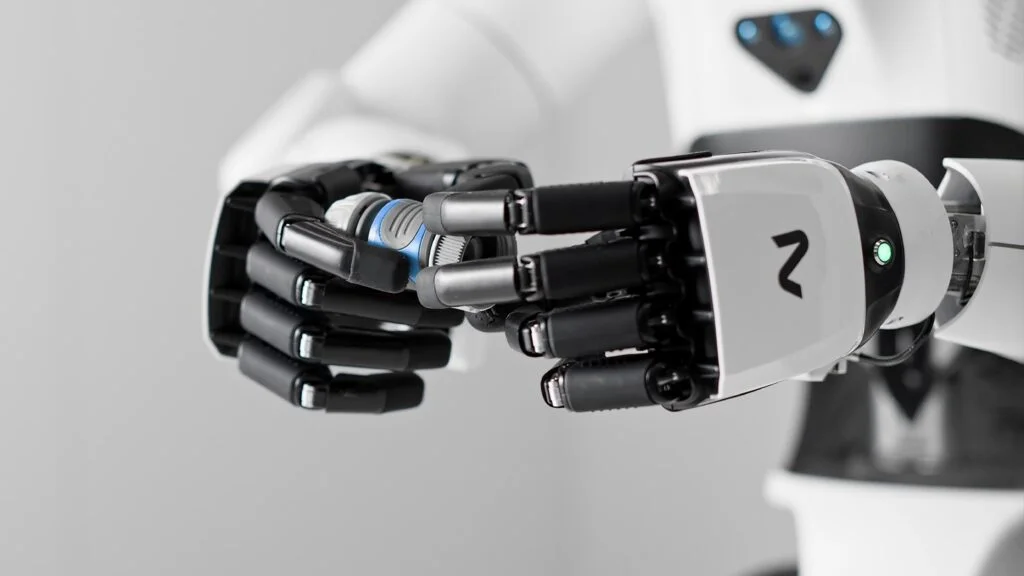
Neura Robotics has introduced Neuron AI, a foundation model designed to give robots a greater understanding of the physical world by combining vision, touch, sound, robot state and language with memory.
According to the Metzingen, Germany-based company, the model uses what it calls a Perception-Language-Action architecture to connect information from different sensors with a robot’s previous actions to help them perform tasks where cameras alone do not provide enough information.
“An intelligent robot needs a brain that brings its senses together and remembers what happened,” founder and CEO David Reger said. “With Neuron AI, we are building the brain of the physical world: Physical AI that turns human expertise and physical experience into capabilities robots can learn and apply. Developed in Germany, built for the world.”
Neura said Neuron AI processes 3D vision alongside tactile and force data, audio, robot-state information and language. Those inputs are aligned over time and converted into physical actions, so even if the camera isn’t able to provide information to the robot, it can still complete its task.
A robot opening a lock, for example, may need to feel or hear whether the mechanism has engaged. Touch can also allow a robot to manipulate an object outside its field of view, while audio can provide additional information during processes such as welding.
Memory
Memory is another key part of Neuron AI and Neura said the model is designed to maintain context as a robot moves through a task through remembering objects after they disappear from view and tracking how previous actions have changed the environment. That allows a robot to understand, for example, that an object it placed earlier still exists even when it is no longer visible, or that an action such as pushing, tightening or opening something has altered what should happen next.
Neura said it adapted Neuron AI’s architecture specifically to support this kind of memory and trains the model on datasets that require robots to use information from earlier stages of a task. Combined with touch, audio and robot-state data, robots connect cause and effect over longer sequences rather than reacting only to the latest camera image.
Training Neuron AI
Neura said Neuron AI is trained using three sources of physical-world data:
- Real-world robot data: Robots operating in Neura Gyms generate synchronized vision, touch, force, audio and movement data across different embodiments and tasks.
- Simulation data: Neura’s Data Amplifier and simulation tools expand the training set by creating variations of tasks and environments.
- Human demonstrations: People wearing sensor-equipped data suits perform tasks that capture human movement and practical expertise for the training pipeline.
Neura said the combined data is used to train a shared foundation model across five robot embodiments equipped with different grippers and hands.
Neuraverse Connected
Neuron AI was developed and trained in Metzingen. Neura said industrial data partnerships with companies including Schaeffler and Bosch supplement information generated through its own Neura Gym robot-training infrastructure.
The company is connecting model development with its Neuraverse platform, which is designed to distribute and update capabilities across robot fleets. Customers can also fine-tune models for their own processes and keep resulting skills private, according to Neura.
Neura is using what it calls “Time-to-Skill” as one measure of progress, referring to how quickly a robot can learn a task and perform it reliably. The company noted that reducing that time is particularly important for industrial users that need robots to adapt as production requirements change.
To show Neuron AI’s planning, multisensory perception, memory and physical action working together across a longer sequence rather than as isolated robot movements, the company plans to demonstrate the model at Nvidia GTC Berlin from Oct. 20 through Oct. 22. Its 4NE1 humanoid robot will perform an 11-minute laundry task that includes sorting clothing, loading and unloading a washing machine and transferring laundry to a dryer without human intervention.