Insider Brief
- RoboParty has launched RP1, a full-stack open-source humanoid robot for robotics research and embodied AI development, with access to both hardware and software.
- RP1 comes in standard and Pro versions with 24 and 30 actuated degrees of freedom, respectively, and supports modular hardware, whole-body control, VR teleoperation, motion capture and simulation-to-real-world workflows.
- The platform extends RoboParty’s RPO open-source project and includes access to ROMOMO actuators, control software, firmware, simulation tools and learning frameworks, with RP1 also available through GitHub.
RoboParty has launched RP1, a full-stack open-source humanoid robot designed for robotics research and embodied AI development, giving developers access to both the machine’s hardware and software.
According to the Shanghai-based company, RP1 allows researchers to modify the robot’s mechanical design, actuators, control systems and software rather than work through a closed interface. The platform includes technical resources for RoboParty’s ROMOMO joint actuators, low-level drivers, control algorithms, firmware, simulation tools, software development kits and robot-learning frameworks to make it easier for researchers to trace failures across the full system. If a robot misses a movement, for example, developers can examine whether the problem came from the AI model, control policy, actuator response or mechanical design.
“We believe the future of embodied AI should not be defined by just a handful of closed systems,” founder Yi Huang said in the announcement. “With RP1, we want to open up more than code. We want to give researchers the opportunity to truly understand, modify and continuously advance robotic capabilities. When more teams can innovate on a shared technical foundation, the entire industry can move further forward.”
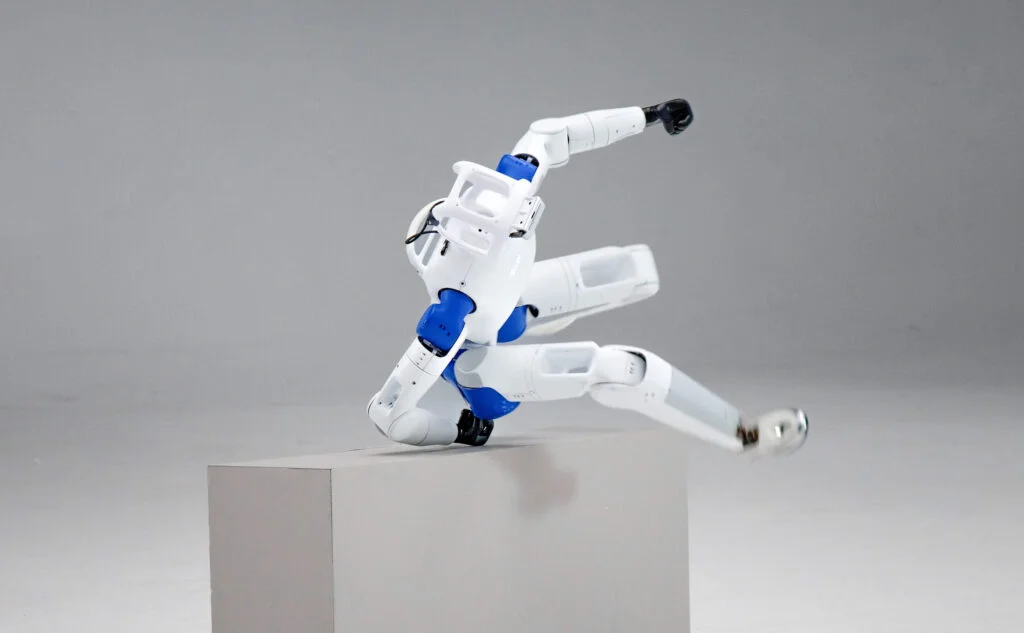
RP1
RP1 is available in standard and Pro configurations:
- Standard RP1: About 1.3 meters tall with 24 actuated degrees of freedom, aimed at gait, balance and simulation-to-real-world research.
- RP1 Pro: 30 actuated degrees of freedom, including a two-degree-of-freedom neck and two seven-degree-of-freedom arms, excluding the hands.
- Modular hardware: Interchangeable head modules and wrist end effectors, including RoboParty’s RP Hand dexterous hand.
- Built-in movement: Continuous walking, recovery from disturbances, standing after falls and human-motion tracking.
- Research tools: Support for virtual-reality teleoperation, motion capture, data collection and playback, motion retargeting and whole-body control.
The company said whole-body control coordinates the robot’s arms, torso and legs for movements that combine locomotion and manipulation. RP1 also works with RoboParty’s PartyOS embodied AI system, its UFO reinforcement-learning framework and MimicLite motion-imitation technology.
The platform includes a development workflow from data collection and simulation training to deployment on physical robots and testing. Researchers can compare model outputs with the robot’s actual behavior and then adjust control policies or hardware configurations.
RoboParty said it has also focused on consistency across the robot’s mechanical structure, actuators and manufacturing process so researchers can repeat experiments without hardware variation becoming a major source of differences.
The RP1 is an extension of its RPO open-source project rlease of mechanical and electrical designs along with training and deployment materials that was launched in January. RoboParty said the project has received more than 2,600 stars on GitHub, where RP1 is also available.