Insider Brief
- Tokyo Boeki Holdings and South Korea’s PLAiF agreed to explore physical AI-based assembly automation for Japanese manufacturers, with work covering market feasibility, technical evaluations and potential commercialization.
- PLAiF will provide dual-arm robotic assembly and fastening technology and technical support, while TBH will identify customer needs, organize proof-of-concept projects and support local sales and business development.
- The partnership is initially focused on validating market demand and technical fit before either company moves toward broader deployment or a commercial business model in Japan.
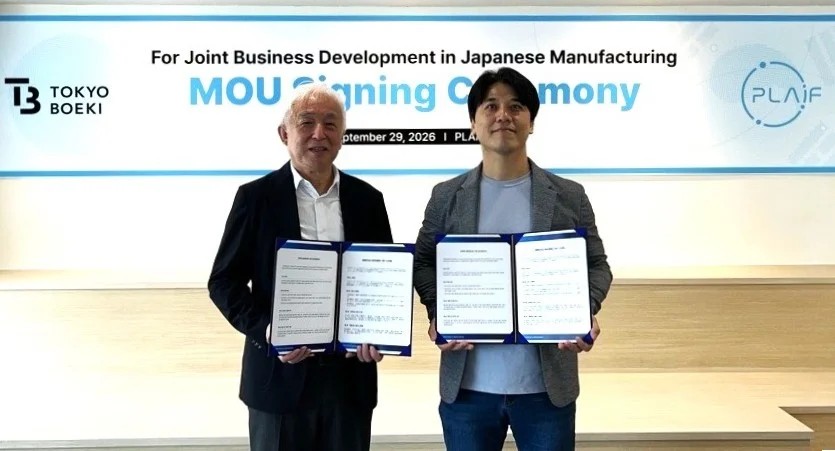
Tokyo Boeki Holdings and South Korea’s PLAiF have agreed to jointly explore assembly automation systems using physical AI for Japanese manufacturers.
According to TBH, the companies signed a memorandum of understanding covering market feasibility studies, technical evaluations and potential commercialization. The partners will use the results of that work to determine how an assembly automation business could be developed for Japanese factories. The companies noted that manufacturing challenges including worker shortages, transferring skills from experienced workers and improving productivity is behind the partnership.
PLAiF develops physical AI technology for manufacturing, including systems that use dual-arm robots for assembly and fastening tasks. Under the agreement, the company will provide its automation technology and technical support for evaluations and demonstration projects.
“This MOU marks the starting point for jointly examining the extent to which assembly automation can actually be applied to manufacturing sites in Japan,” PLAiF CEO Jung Tae-young said in the announcement. “We will then concretize the technologies and business models required by the sites, one by one.”
TBH will focus on identifying potential customers and automation needs through its manufacturing network in Japan. The trading company group will also help plan proof-of-concept projects and support sales and business development.
“By combining Plife’s assembly automation technology with Tokyo Boeki Group’s experience in the Japanese manufacturing market, we will explore business opportunities tailored to our customers’ sites,” added Hiroto Mizuhara, CEO of the TBH smart manufacturing segment. “Through the verification process, we hope to find a direction for long-term collaboration between the two companies.”
Dividing the Work
TBH will handle market development, identify manufacturing processes that could benefit from automation and work with customers on proof-of-concept projects. It will also provide local sales and business development support.
PLAiF will provide physical AI-based assembly automation systems, including dual-arm robotic technology for assembly and fastening. The company will support technical testing and modify its systems based on requirements identified during Japanese trials.
The agreement represents an early step toward commercialization rather than a commitment to specific deployments. TBH and PLAiF plan to first evaluate market demand and whether the technology can perform the targeted manufacturing tasks before developing a business model for the Japanese market.