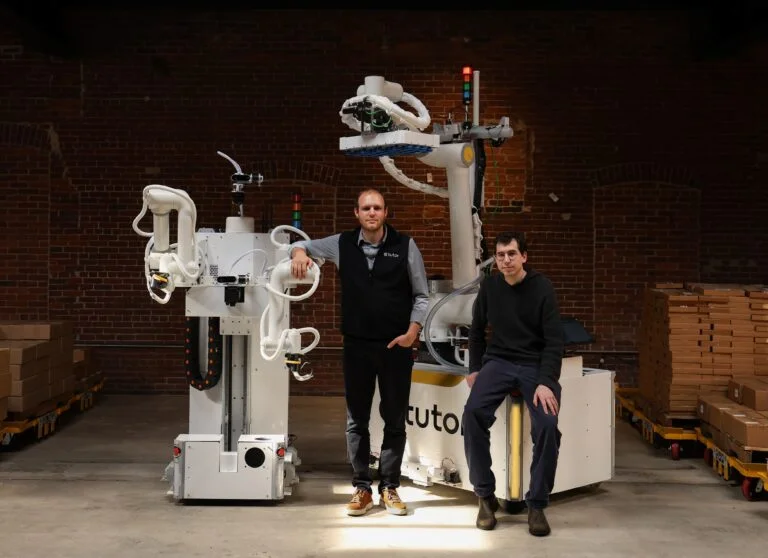
Boston Dynamics Unveils Stretch Gen 2 Autonomous Trailer-Unloading Robot
 By Greg Bock · · 3 min read

Insider Brief
- Boston Dynamics has unveiled Stretch Gen 2, an upgraded autonomous trailer-unloading robot designed to improve reliability, reduce downtime and simplify maintenance in warehouses and distribution centers.
- Drawing on more than 100,000 operating hours from its first-generation robot, the company redesigned Stretch with upgraded electrical systems, improved gripping and sensing, fewer cables and modular components that speed repairs.
- Stretch Gen 2 can unload up to 1,000 cases per hour, depending on operating conditions, with a battery that lasts two shifts, fast charging and software updates that improve performance without hardware changes.
Boston Dynamics has introduced Stretch Gen 2, an updated version of its autonomous trailer-unloading robot designed to reduce downtime, simplify repairs and improve performance in warehouses and distribution centers.
The redesign draws on more than 100,000 operating hours and tens of millions of boxes unloaded by the first-generation Stretch, according to the company. Engineers used that data to identify common causes of equipment failures and develop hardware changes to improve reliability.
Brian Donnelly, vice president and general manager of logistics robotics at Boston Dynamics, said customers rely on Stretch to keep freight moving, making robot downtime a costly disruption that creates backlogs on loading docks.
“With Gen 2, we focused on the things that actually took robots offline in the real world,” Donnelly said. “We made it tougher, we made it simpler to service, and we made sure it keeps getting better long after it’s deployed.”
The new model features a modular design that allows maintenance teams to replace components more quickly, along with upgraded electrical connections, improved sensing and a redesigned gripper.
Among the hardware changes, Boston Dynamics highlighted several improvements:
- Electrical systems: Heavy-duty automotive-grade connectors withstand vibration from handling boxes and moving across uneven floors, while an 81% reduction in internal cabling eliminates about half a mile of wiring.
- Gripper: New valves and more precise sensors improve how the robot grasps and places boxes.
- Joints: Continuous rotation joints can move beyond 360 degrees without hitting mechanical stops, reducing stress on components.
- Safety and durability: A lower, recessed emergency stop and redesigned exterior panels help prevent accidental shutdowns and damage from falling boxes.
- Maintenance: Standardized fasteners and modular components simplify repairs, while onboard diagnostics allow customers’ maintenance teams to perform more routine service.
According to Boston Dynamics, replacing a complete swerve drive assembly now takes about one hour, compared with a full day on the previous model. The company also eliminated complex wiring harnesses and introduced maintenance tools intended to reduce reliance on outside service technicians.
Stretch Gen 2 retains the ability to unload up to 1,000 cases per hour, although Boston Dynamics noted that performance depends on factors such as box weight and how neatly cases are stacked. A multipick feature allows the robot to handle multiple cases during unloading.
The battery supports two shifts of operation, and fast charging can restore it to 90% capacity in about 75 minutes. Built-in lighting allows the robot to work inside dark trailers, while its pre-trained vision system can identify most packages without additional programming, the company said.
Stretch Gen 2 also uses a redesigned onboard computing platform that supports regular software updates for better package detection, movement planning, picking strategies and the robot’s ability to understand its surroundings without requiring hardware changes.