AI Is Helping Build Better AI, METR Assessment Finds
 By Matt Swayne · · 4 min read
Insider Brief
- METR estimates that Anthropic’s benchmark progress accelerated 1.9-fold after October 2025, with AI use likely accounting for most of the current acceleration.
- Progress remains driven primarily by AI assisting human researchers, creating a potential feedback loop in which better models help develop more capable successors.
- METR identified no clear bottleneck to further acceleration over the following year, although uncertainty and redacted evidence limit its conclusions.
AI is helping Anthropic develop more capable models faster, according to METR’s AI R&D assessment that points to a feedback loop central to the prospect of recursive self-improvement.
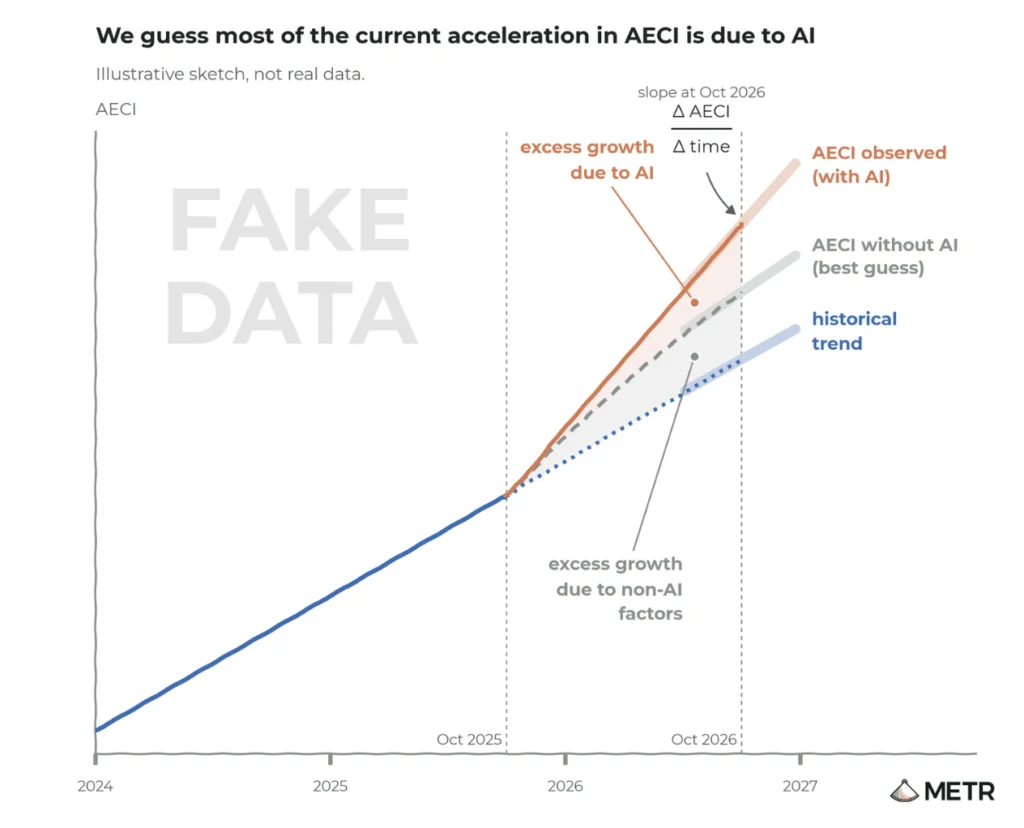
METR analysts estimate that Anthropic’s benchmark progress accelerated 1.9-fold after October 2025—roughly two years of historical progress in one year. They judge that AI use likely accounts for most of the current acceleration and ruled out faster growth in training compute as its explanation.
The finding puts AI development itself among the activities that AI can help accelerate. For enterprise leaders, it raises a planning question of how companies should invest when the tools available during deployment could advance faster than their earlier trajectory suggests.
A Feedback Loop in AI Development
Recursive self-improvement describes a process in which improvements to AI help produce further improvements. A more capable system could help researchers develop its successor, which could then become a more effective research assistant.
The potential consequence is compounding progress. Each generation could contribute to the work needed to develop the next, increasing the research capacity available to a laboratory.
At Anthropic, the acceleration remains driven primarily by AI assistance to human researchers, according to METR analysts. They also identified no clear bottleneck that would prevent further acceleration over the following year.
That makes the relationship between research productivity and model development a useful place to examine the possibility of a faster transition toward artificial general intelligence, or AGI—broadly, AI able to perform a wide range of intellectual work.
The question extends beyond how well a model performs today. It includes how effectively that model can contribute to the development of more capable systems.
According to METR’s AI R&D assessment framework, the question can be examined through three lines of inquiry — whether capabilities are improving faster, how much of any acceleration comes from AI and whether constraints could slow future growth. According to the analysts, examining those questions requires information about research inputs as well as model performance.
The Enterprise Planning Question
For businesses adopting AI, an accelerating development cycle could change the economics of implementation.
Consider a company building a system to process complex documents. Its investment might include connecting internal records, defining acceptable outputs, establishing review procedures and developing software around the model. More capable models could expand what that system can handle, potentially changing which work requires employee attention.
The resulting planning challenge would include deciding which parts of an implementation need frequent reassessment. A business case built around current model performance could change as new capabilities become available.
The same reasoning applies to internal research. Faster completion of individual tasks could create value, but leaders would also need to examine whether those gains improve the pace or quality of finished work.
According to METR’s framework, measuring AI’s contribution requires examining labor, computing resources, data and algorithmic progress, alongside interviews with researchers. It also recommends considering several measures of capability, including benchmarks and intermediate indicators of training progress.
For an enterprise research team, the corresponding question would be whether AI helps deliver better results with the resources available. Measuring that outcome would require following work through to completion, including the review and integration needed to make it useful.
Limitations and Future Assessment
METR analysts acknowledge uncertainty in their attribution of acceleration to AI. According to the assessment, the evidence emphasizes well-specified tasks, and Anthropic redacted much of the material that informed the conclusions. The assessment establishes neither an AGI timetable nor autonomous recursive self-improvement.
METR’s framework identifies a further challenge that evaluators may need to determine whether their methods would reliably detect much more dramatic acceleration. It recommends access to unreleased-model measurements, research inputs and forecasts to investigate that possibility.
Access and publication remain separate issues. According to Anthropic’s update on independent evaluators, evaluators can examine sensitive internal information while the company retains rights to redact material in predefined categories, including confidential intellectual property.
In the future, assessments will need to track both the pace of improvement and the evidence connecting it to AI-assisted research, giving business leaders a firmer basis for judging how quickly their technology assumptions may need to change.