- Shanghai Kepler Robotics began mass production and shipments of its K2 “Bumblebee” humanoid—described by the company as the world’s first commercially available hybrid-architecture unit—marking a shift from prototypes to scaled deliveries.
- The K2 combines planetary roller-screw linear and rotary actuators for a straight-knee bipedal gait and industrial durability validated in environmental and endurance tests, with up to 81.3% energy efficiency, ~8 hours per charge, a 30-kg dual-arm payload, and a listed price of RMB 248,000.
- Kepler says it has framework agreements for several thousand units worth hundreds of millions of yuan, targeting logistics, manufacturing, R&D and exhibitions while building a supply-chain ecosystem to standardize, service and scale deployments.
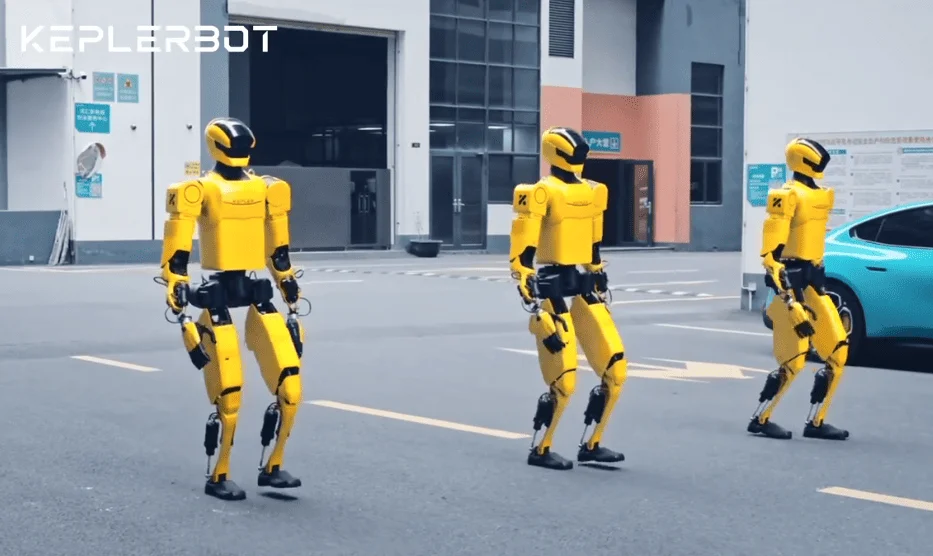
PRESS RELEASE – Shanghai Kepler Robotics Co., Ltd (“Kepler Robotics”) has announced the start of mass production for its K2 “Bumblebee” model, confirming through a recently released video that the world’s first commercially available hybrid-architecture humanoid robot has begun shipping to customers.
The start of large-scale production and deliveries marks a major step forward in the global commercialization of humanoid robotics. Kepler Robotics has transitioned the technology from research prototypes to fully market-ready systems. The achievement represents a key milestone not only for the company, but also for the humanoid robotics industry, signaling the beginning of its production-scale era worldwide.
Mass Production and Commercial Rollout: Built on Strong Technical Foundations
The move into mass production for the K2 “Bumblebee” is more than a shift from research to manufacturing; it represents a structural change in how the global humanoid robotics sector is evolving.
The production video highlights the K2 “Bumblebee” executing a straight-knee bipedal gait, as well as assembly line operations, component testing, high/low-temperature environmental tests, system aging trials, obstacle navigation, thousands of hours of continuous uptime without failure, and dynamic performance evaluations—all confirming the model’s readiness for real-world deployment.
The K2 “Bumblebee” features a hybrid serial-parallel design that combines roller screw linear actuators with rotary actuators. This architecture provides enhanced stability, extended operating life, and optimized performance for industrial environments. Because of the system’s technical complexity and high development costs, only a limited number of robotics companies worldwide have reached this level. The successful rollout of the K2 “Bumblebee” demonstrates that Kepler Robotics has achieved mass production and delivery on a technological platform aligned with international leaders.
Scaling production has been enabled by Kepler Robotics’ success in solving core technical challenges. To achieve a human-like straight-knee gait, the R&D team conducted in-depth research into screw mechanics rather than adopting the more common quasi-direct-drive approach. The planetary roller screw—a precision transmission component that converts rotary to linear motion—offers high efficiency, precision, load capacity, smooth operation, and long-term durability. By integrating planetary roller screw linear motors with rotary motors for joint actuation, the K2 “Bumblebee” achieves fine-grained joint control, even while executing high-load and complex movements.
To achieve a more natural walking motion, Kepler Robotics has invested heavily in bridging the “Sim-to-Real” gap—the discrepancy between simulated and real-world conditions that can introduce dynamic inaccuracies, sensor noise, delays, and computational lag, complicating torque control. The R&D team applied reinforcement learning and imitation to train the robot. Through reinforcement learning, the robot learned human-like walking behaviors via simulation and iterative optimization. GPU-accelerated physics simulation enabled parallel training for thousands of robots, each exposed to varied parameters and environments, producing a robust walking control strategy. In imitation learning, a high-fidelity physics simulator allowed the robot to replicate human gait characteristics—including heel strike, toe-off, and coordinated limb movement. Reward strategies further guided the robot to emulate human motion patterns while optimizing for speed, energy efficiency, and resistance to external disturbances.
Mass production and commercial deployment have now moved from ambition to reality. The concept of a “first year of mass production” for humanoid robots is now coming into clear focus, signaling a transition from a capital-driven phase to one defined by scalable market adoption and measurable customer value.
From Concept to Productivity: A Tool for Real-World Workflows
The K2 “Bumblebee” delivers competitive advantage by providing measurable value to customers, bringing the idea of “humanoid robots in the workplace” into practical, real-world use.
Purpose-built for industrial integration, the K2 “Bumblebee” achieves up to 81.3% energy efficiency with its hybrid architecture, allowing for up to eight hours of operation on a single charge. Its human-like straight-knee walking gait enables agile navigation and obstacle avoidance in complex spaces such as logistics centers and factory floors. With a dual-arm payload capacity of up to 30 kg, the system is capable of carrying, loading, and unloading tasks. It also incorporates a layered (VLA+) model to process semantic commands, enabling accurate execution of tasks including sorting, assembly, and guided tours. Ready for immediate deployment, the K2 “Bumblebee” is designed for logistics, manufacturing, R&D, government exhibitions, and specialized operations, delivering clear operational benefits.
The K2 “Bumblebee” is priced at RMB 248,000 per unit, breaking through the million-yuan threshold of prototype humanoid robots and significantly lowering barriers for large-scale adoption. This competitive price point makes advanced robotics accessible to a broader range of customers.
Building an Industry Ecosystem: Scaling Adoption Across Sectors
To date, Kepler Robotics has signed framework agreements covering several thousand units, with total contract value in the hundreds of millions of yuan. Customers include companies in industrial services, data operations, exhibitions, smart manufacturing, and specialized applications.
Commercial rollout is just the starting point. The company is committed to accelerating the development of a global humanoid robotics ecosystem. Current barriers—such as fragmented standards, low deployment efficiency, and limited local service networks—continue to slow adoption. Kepler Robotics is partnering across the supply chain to establish an integrated “technology-to-market” strategy to overcome these challenges. Since early 2025, the company has completed three funding rounds, adding strategic investors including Tao Motor, Friend, Zhaofeng, Hanwei, Jirfine Intelligent Equipment, Veichi, and Keli Sensing. With a hardware-first approach, Kepler Robotics secures critical positions in the supply chain, ensuring stable component sourcing while driving down costs through scale production, making humanoid systems more accessible and cost-effective.
As humanoid robots move into operational environments, they are becoming essential nodes within industrial ecosystems. In manufacturing, the K2 “Bumblebee” can take on repetitive tasks; in specialized fields, it can execute high-risk operations, enhancing both productivity and safety.
Through ongoing innovation and deeper ecosystem collaboration, Kepler Robotics will continue reducing barriers to humanoid adoption—accelerating industry-wide deployment and enabling more organizations to realize the benefits of advanced automation.
Image Credit Kepler Robotics.