

Insider Brief
- Flexion, a Zurich-based robotics startup building an autonomy platform for humanoid robots, raised $50 million in Series A funding, led by DST Global Partners with participation from NVentures, Redalpine, Prosus Ventures and Moonfire, following a $7.35 million seed round.
- The company said the capital will expand its R&D team, scale compute and robot fleets, establish a U.S. presence and accelerate commercial partnerships with major OEMs as it moves its autonomy stack toward deployment.
- Flexion is developing an intelligence layer for humanoid systems that integrates language-based task reasoning, a vision-language-action model and transformer-driven whole-body control to reduce reliance on human demonstrations and enable adaptable, general-purpose robotics in real-world industrial environments.
Flexion, a Zurich-based robotics startup developing an autonomy platform for humanoid robots, raised $50 million in Series A funding to accelerate development of its AI-driven control stack. The round was led by DST Global Partners with participation from NVentures, Redalpine, Prosus Ventures and Moonfire, following a recent $7.35 million seed round.
Nikita Rudin, Co-Founder & CEO of Flexion, said in a blog post announcing the funding that the new capital will be used to expand its research team, scale compute and robot fleets, build a U.S. presence and move toward commercial deployment with major OEM partners.
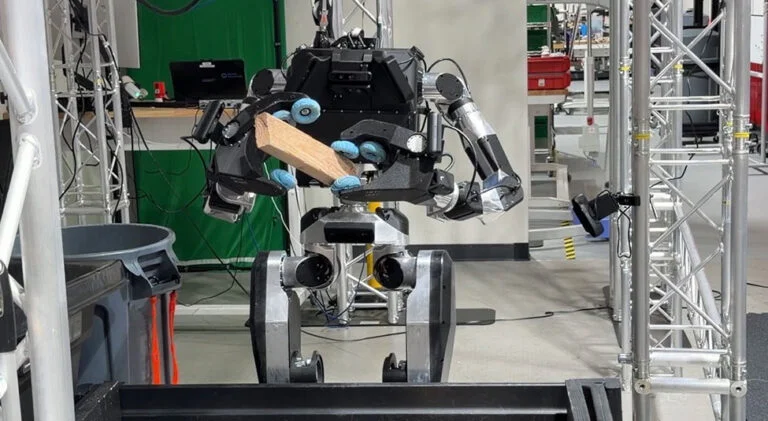
Flexion is developing what it describes as an intelligence layer for next-generation humanoid systems, aiming to shift the field away from heavily scripted, task-specific robots toward adaptable machines that can operate with minimal human involvement, according to the company. The company’s platform integrates three components: a language-based command system for task reasoning and grounding, a vision-language-action model trained largely on synthetic data and fine-tuned for real-world edge cases, and a transformer-based whole-body control system designed to support rapid creation of new behaviors.
The company said this architecture is intended to address one of robotics’ central bottlenecks: the need for extensive human demonstrations and teleoperation to teach robots individual tasks. By leveraging simulation, large-scale training and modular control, Flexion aims to reduce reliance on manual data collection and enable robots to perform a broader range of activities in environments such as manufacturing, logistics and disaster response.
“Around the world, humanoid robots look impressive, but few can perform useful, scalable work outside controlled settings,” Rudin wrote. “The missing piece isn’t mechanics, it’s intelligence. Flexion is building that intelligence layer, the brain that will turn capable machines into adaptable, autonomous systems.
Flexion’s founders, who previously worked across ETH Zurich, NVIDIA, Meta, Google, Tesla and Amazon, are targeting what they see as an inflection point for robotics. Advances in compute infrastructure, the rise of large-scale AI models and growing labor shortages across industrial economies are accelerating demand for autonomous systems capable of general-purpose work. While hardware platforms have advanced quickly, the company said the field still lacks the software intelligence required to make humanoid robots commercially useful at scale.
“Our mission is simple but ambitious: to power the intelligence stack for humanoid robots, so they can work alongside humans, not depend on them,” Rudin noted.
Image credit: Flexion