Insider Brief
- Dyna Robotics introduced Dyna-2, a robot foundation model trained on more than 1 million hours of first-person human video and designed to predict how actions will change the physical world before a robot moves.
- The company said performance improved predictably as more human-video data was added, with reported results including an 87% quality pass rate in one customer deployment versus 46% for Dyna-1 and manufacturing-task success rates rising from about 20% to 90% with increased pre-training.
- Dyna said Dyna-2 can transfer to different robot platforms with relatively little additional training, including an experiment in which 13 minutes of robot-specific data was enough to train two five-fingered hands to open a bottle cap.
Dyna Robotics has introduced Dyna-2, a robot foundation model it says was trained on more than 1 million hours of first-person human video.
The California-based company describes its Dyna-2 as a world action model designed to learn how actions change the physical world by watching human activity. Unlike many robot models that depend heavily on teleoperation data collected by having people remotely control robots, DYNA-2 was pre-trained entirely on the equivalent of 170 years-worth of human experience through video, the company said.
“For years, generalist robotics has been choked by a data bottleneck: collecting physical teleoperation data manually simply cannot scale to general intelligence,” co-founder Jason Ma said. “Action data is scarce, but video is everywhere, and with Dyna-2, we showed that physical intuition doesn’t require millions of hours of training on a robot arm — it can be learned directly from human video. By building a world-action model that imagines how the physical world moves before taking action, we give robots spatial reasoning and contact physics that traditional vision-language models simply lack and show that physical AI can scale smoothly and predictably, unlocking commercial-grade automation far faster than previously thought possible.”
Dyna indicated research shows robot performance improved as additional human-video data was added to training and called the result a human-to-robot scaling law and that performance increased in a relatively predictable way as the amount of training data grew.
Dyna-2 uses two related training objectives. The model learns to predict what the next video frame should look like and what action should follow, giving it information about movement, spatial relationships and how objects respond to contact.
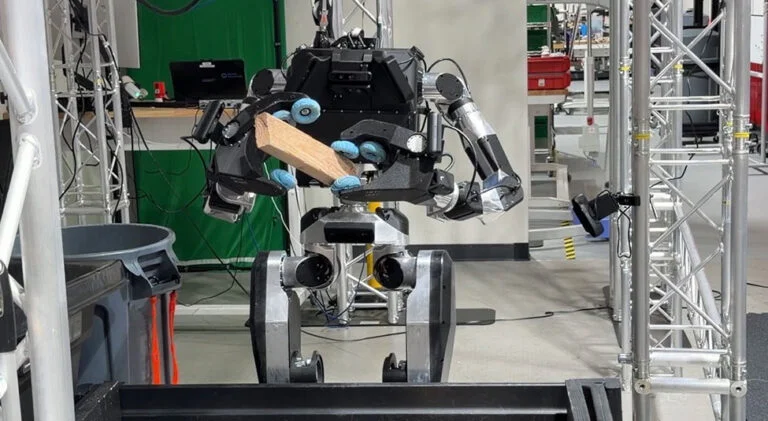
Dyna said those capabilities can then be transferred to different types of robots with relatively small amounts of additional training and that it has tested the model on stationary robot arms, humanoid prototypes and five-fingered robotic hands.
Dyna-2 Results
Some of the reported results include:
- Pre-training data: More than 1 million hours of human egocentric video.
- Benchmark tasks: Performance improved across 15 tasks as additional human-video data was used in pre-training.
- Fine-tuning: In one experiment, 13 minutes of robot-specific data was enough to teach two five-fingered hands to twist open a bottle cap.
- Manufacturing tasks: Success rates rose from about 20% to 80% to 90% as pre-training increased, without changing the post-training dataset.
- Zero-shot deployment: DYNA-2 recorded an 87% quality pass rate in one customer deployment, compared with 46% for the earlier DYNA-1 model.
- Instruction following: Dyna said video co-training improved scores by 133% on tasks requiring different movements based on user commands.
The company compared Dyna-2 with Dyna-1, its earlier vision-language-action model. VLA models typically connect what a robot sees and what a person tells it to do with an action. Dyna-2 instead centers on predicting how the physical scene will change before determining the robot’s next movement.
Dyna said Dyna-2 and Dyna-1 both reached a 99.9% task success rate in one set of real-world tests, but DYNA-2 produced a customer-quality pass rate 1.55 times higher. The newer model also recovered from physical disturbances during manipulation tasks such as chopping food and clearing workspaces without human intervention, according to the company.
Dyna already uses its earlier Dyna-1 model in robots deployed in hotels, restaurants and laundromats. With Dyna-2, the company is trying to make it easier to adapt robots to new tasks and hardware without collecting large amounts of fresh teleoperation data for each deployment.