
Insider Brief
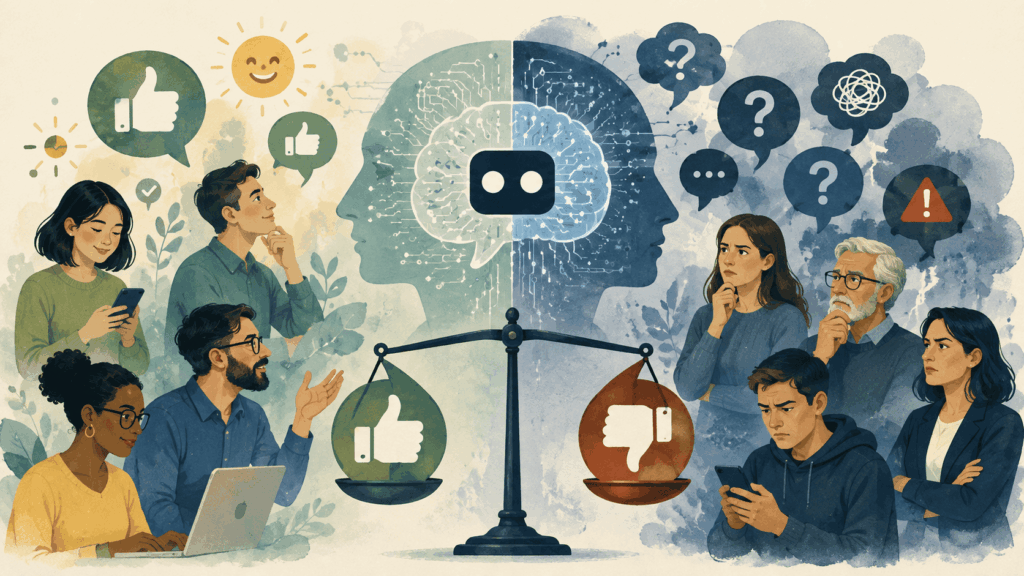
- Drexel University researchers found expressions of trust in generative AI in about 31% of more than 230,000 Reddit posts analyzed from 2022 to 2025, compared with 26% expressing distrust.
- Trust was more common among business leaders, academics, developers and technology professionals, while distrust appeared more often among the general public, AI ethicists and journalists.
- Direct experience with AI was the leading factor behind both trust and distrust, with users focusing more on accuracy, reliability and performance than broader ethical concerns.
How much do users of generative AI trust what it produces?
Drexel University researchers set out the answer to that question and report that expressions of trust in generative AI modestly outweighed distrust across hundreds of thousands of Reddit posts published between 2022 and 2025. According to the researchers, trust appeared in about 31% of posts, compared with 26% expressing distrust. About 41% expressed neither, while roughly 1% expressed both.
The study, published in Transactions of the Association for Computational Linguistics, analyzed more than 230,000 posts from 39 AI-related subreddits between November 2022 and June 2025. Researchers examined discussions involving systems including ChatGPT, LLaMA and Claude.
“These findings give us an important starting point and help to establish a baseline understanding which can help inform responsible AI design, governance and literacy efforts,” noted lead researcheer Shadi Rezapour, PhD, an assistant professor in the Nick Howley College of Engineering and Computing. “It will be important to see how these attitudes around trust and distrust evolve as the technology becomes more widely used.”
According to the researchers, the results suggest attitudes remained mixed throughout the period as trust generally stayed ahead of distrust, but the gap shifted over time and distrust briefly moved ahead during some periods.
Researchers also pointed out that those changes often coincided with major product launches and announcements. Trust increased modestly around several releases in 2023, including GPT-4 and LLaMA 2, while distrust rose around OpenAI’s Dev Day later that year.
How Researchers Defined Trust
“We defined trust as a belief that Generative AI is reliable, competent or acts with integrity, leading people to have positive expectations about its performance or behavior,” doctoral candidate in the School of Computer and Information Sciences and lead author Aria Pessianzadeh said. “Distrust is more than simply the absence of trust. It reflects active skepticism or concern about the technology’s reliability, competence or ethical implications, which can lead to negative expectations or more cautious behavior.”
Researchers also divided posters into 10 groups based on self-identifying information in their posts. Those groups included generative AI users, software developers, researchers, technology workers, members of the general public, journalists, business leaders, AI ethicists, artists and educators.
Trust was more common than distrust among posts associated with business leaders, academics, software developers and technology professionals, researchers noted. Distrust appeared more often among the general public, AI ethicists and journalists. Generative AI users, the largest group in the dataset, showed a more even split between trust and distrust. Educators and knowledge workers followed a similar pattern.
Performance Matters Most
Across groups, direct experience with AI was the most common reason people gave for either trusting or distrusting the technology and the discussions focused more heavily on whether AI systems worked reliably than on broader ethical questions. Users were more likely to judge systems based on accuracy, competence and consistency than on issues such as transparency or integrity, researchers reported
That, researchers said, suggests trust is often shaped by practical experience because systems perform well, users are more likely to express confidence. On the other hand, when they produce errors or fail at tasks, distrust rises.
The researchers indicated ethical concerns were still present, but appeared less often in everyday discussions than questions about whether the technology could produce useful and reliable results.
Limits of the Study
The researchers cautioned that Reddit users are not representative of the broader population. The dataset also included only English-language posts and focused on communities already discussing AI. Also, the nature of discussions could help explain why practical questions about performance appeared more frequently than broader ethical concerns.
Future research could expand the analysis to other social platforms, languages and populations, researchers suggested.
Given how quickly AI has been adopted, divided views are likely to persist, Rezapour said. As the technology becomes more common in everyday life, researchers will need to track how trust changes and which experiences, new capabilities and industry developments shape those attitudes.
“These findings are a useful starting point, but trust in AI is not static and people’s attitudes change based on their experiences with these systems, new capabilities and major developments in the technology,” Rezapour said. “Therefore, researchers should continue to examine how attitudes about AI technology evolve in the coming years.”