Insider Brief
- Nvidia introduced Jetson Orin Nano 2, a compact robotics computer for entry-level edge AI applications including robots, drones and machine-vision systems.
- The module delivers 78 TOPS of AI performance, 8 GB of memory and an 8-core Arm CPU, with Nvidia reporting twice the inference performance of Jetson Orin Nano Super and 40% lower power use at equivalent performance in 15-watt mode.
- Cognex, Doosan Bobcat and Matic are among the early adopters or evaluators, while Nvidia expects the Jetson Orin Nano 2 module and developer kit to become available in the first half of 2027.
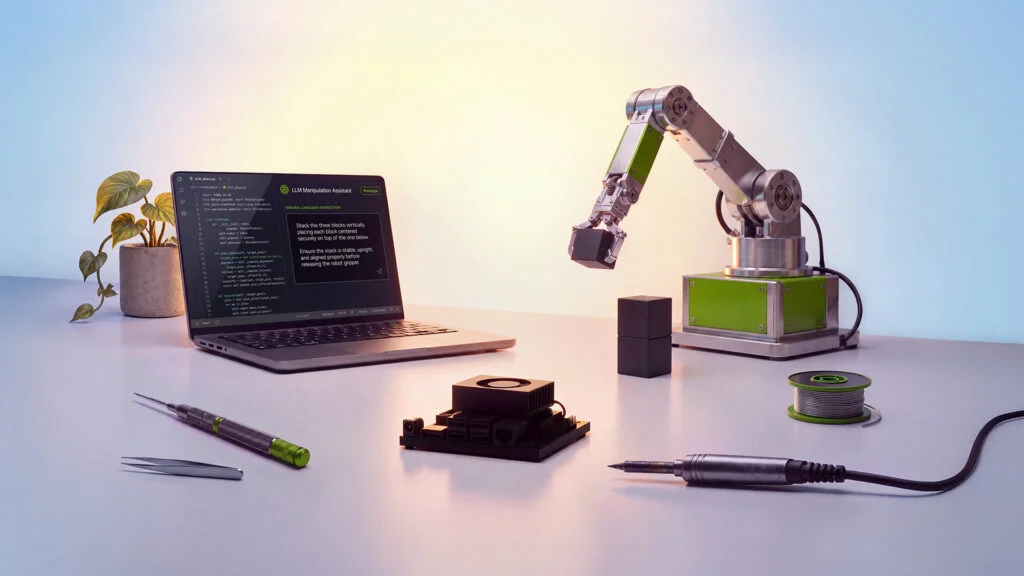
Nvidia has introduced Jetson Orin Nano 2, a compact robotics computer aimed at entry-level edge AI applications including robots, delivery and inspection drones, and machine-vision systems.
According to Nvidia, the new module delivers twice the inference performance of the previous Jetson Orin Nano Super while retaining the same form factor. At equivalent performance, Nvidia said Jetson Orin Nano 2 uses 40% less power when operating in 15-watt mode.
The system is designed to run AI models directly on devices rather than relying on remote computing infrastructure. Nvidia said that can support applications that need real-time perception, language understanding and decision-making at the edge.
The company indicated it is meant for smaller autonomous systems where available computing power and energy consumption are both constrained. The platform is intended to give developers enough onboard processing to run newer AI models while remaining within the power limits of compact robots and other edge devices.
Jetson Orin Nano 2 Specifications
- AI performance: 78 trillion operations per second
- Memory: 8 GB
- CPU: 8-core Arm processor
- Inference performance: 2x Jetson Orin Nano Super
- Power efficiency: 40% less power at the same performance in 15-watt mode
- Form factor: Same size as the previous generation
Nvidia attributed the performance gains to improved Tensor Cores and higher memory bandwidth.
Jetson Orin Nano 2 supports Nvidia’s software stack and Jetson agent skills, allowing developers to run large language models and vision-language models optimized for edge devices. Supported open models include Nvidia Cosmos and Nemotron, along with Gemma 4 and Qwen 3, according to the company.
Nvidia said more than 3 million developers are building on its robotics stack. Cognex, Doosan Bobcat and Matic are among the companies adopting or evaluating Jetson Orin Nano 2. Matic plans to use the computer in its home cleaning robots for applications including conversational AI, gesture detection, mapping, semantic understanding and autonomous cleaning. Alphabet-owned Wing, meanwhile, currently uses Jetson Orin Nano Super and Nvidia software in its delivery drone fleet and plans to evaluate Jetson Orin Nano 2 for real-time perception and reasoning.
Nvidia is also working with partners including Aaeon, Adlink, Advantech, Aetina, Antmicro, Aptiv, AVerMedia, Connect Tech, ForeCR, Seeed Studio and others that are developing carrier boards, hardware systems, customized AI software and reference designs based on the platform.
Nvidia said the Jetson Orin Nano 2 module and developer kit are expected to become available in the first half of 2027.