
Insider Brief
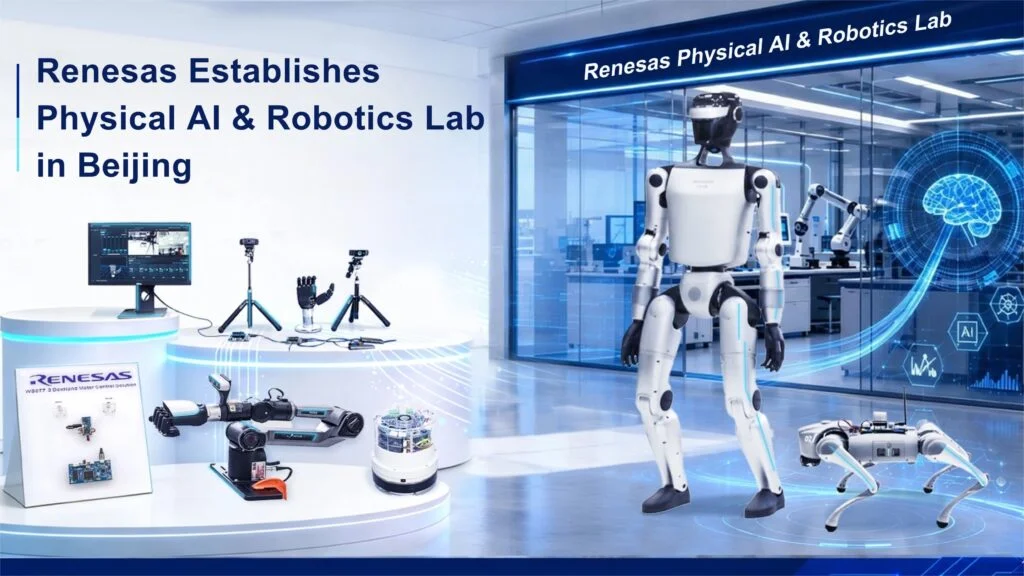
- Renesas Electronics opened a Physical AI & Robotics Lab in Beijing to help customers test, validate and jointly develop robotics systems from proof of concept through deployment.
- The semiconductor company said its products currently address about 30% of a humanoid robot’s bill of materials and sees potential to expand that coverage to 70% across control, power, sensing, AI and software.
- The lab will combine hardware, software, AI models, motion control, sensing and system testing while supporting collaboration with robotics companies, suppliers, universities and startups in China.
Renesas Electronics has opened its Physical AI & Robotics Lab in Beijing to help customers test, validate and jointly develop robotics systems as the Japanese chipmaker expands its push into physical AI.
According to Renesas, the facility will combine hardware, software, AI models, motion control, power systems, sensing and system-level testing. The opening follows Renesas’ creation of a dedicated Physical AI Division on July 1 and is intended to support projects from proof of concept through deployment rather than serve primarily as a product demonstration center.
Renesas said it is focusing on robotics systems that require computing, sensing, actuation and power management to work together in real time. Humanoid robots are one focus because they combine many of those components within a single machine.
“Humanoid robots are becoming more sophisticated and complex, driving demand for hardware and software systems that must work together seamlessly,” said president and head of UX Ivo Marocco. “Today, Renesas can address roughly 30% of the humanoid robot BOM, and we see an opportunity to expand that coverage to 70% through our strengths in control, power, sensing, AI, software and ecosystem solutions. Our new lab will help customers validate complete systems and accelerate the deployment of next-generation robotics innovations.”
The Beijing lab will allow customers to evaluate those components together as part of complete robotic systems. Renesas said it will also use the facility to work with robotics companies, suppliers, universities and startups on system development.
Renesas’ robotics portfolio covers several major parts of a robot architecture, including processors used for higher-level computing and motion control, sensors, actuator controls and power-management components. The company said it is also bringing technologies developed for its automotive and industrial businesses into robotics, including functional-safety systems and edge AI, which allows AI processing to take place directly on machines.
Renesas plans to connect that hardware with Renesas 365, its cloud-based electronics development platform, as it develops tools for designing and deploying robotics systems.
“China continues to lead in robotics innovation and adoption with a deep customer base, a highly collaborative ecosystem and a comprehensive supply chain service system,” said Yvonne Liu, vice president and president of Renesas China. “Renesas will leverage its Physical AI Lab in Beijing and its technology capabilities to collaborate closely with customers, ecosystem partners, universities and startups. As part of Renesas’ key strategy in China, this lab will accelerate the engineering implementation of physical AI systems.”