Insider Brief
- Vention has opened a physical AI research lab in Montreal to turn advances in robotic manipulation into reliable, scalable systems for manufacturing.
- Led by physical AI director Jimmy Li with Cohere chief AI officer Joelle Pineau as an external adviser, the lab will combine industrial data, customer feedback and research in robotics control, motion planning, computer vision, learning from demonstration and reinforcement learning.
- The lab is developing technologies including Vention’s GRIIP manipulation pipeline as physical AI becomes the company’s fastest-growing segment, with related revenue up 400% over the past year.
Vention has opened a physical AI research lab in Montreal to turn turning advances in robotic manipulation into systems that can be deployed across manufacturing.
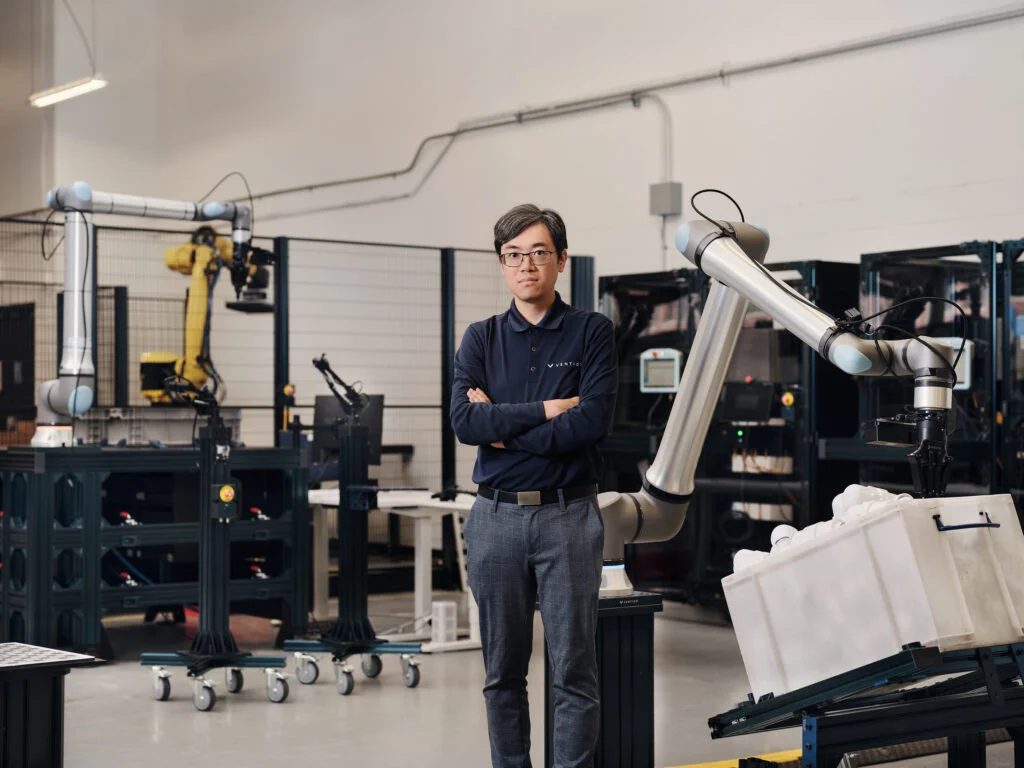
According to the industrial automation company, the lab is led by Jimmy Li, Vention’s director of physical AI, with Cohere chief AI officer Joelle Pineau serving as an external technical adviser.
Rather than developing lab-driven robotics models, Vention plans to use data, production problems and customer feedback from operating factories to guide research and test whether new systems can meet real-world requirements for reliability, cost and changing production conditions.
“What makes this lab different is the loop we’ve built: academic research feeding directly into live production problems, and production feedback feeding back into the research,” noted Jimmy Li, director of physical AI. “Our clients aren’t waiting for a finished product to test; they’re in the room while we build it. That’s unique in this field, and it’s what lets us move faster from a research result to something that actually runs on a factory floor.”
The lab’s research spans several areas.
Robotics control: Developing systems that direct how robots move and respond during industrial tasks.
Motion planning: Determining how robots can move efficiently while avoiding collisions.
Computer vision: Using traditional vision systems and newer foundation models to help robots identify objects and understand their surroundings.
Learning from demonstration: Training robots by showing them examples of how humans or other systems perform a task.
Reinforcement learning: Improving robot behavior through repeated attempts and feedback.
Industrial data and post-training: Collecting factory data and using it to further train AI models for specific production environments.
Vention said the work is focused on manufacturing tasks that remain difficult to automate because objects, environments or processes can vary from one cycle to the next. The company indicated it expects better AI models to reduce the engineering effort and cost required to deploy robots for those jobs.
The Montreal team currently has eight members and is expanding, with more than 16 positions open across robotics control, simulation and Physical AI research. Vention said the lab has already generated intellectual property and expects additional technology to emerge from the program.
GRIIP Robotics Manipulation
One of its first products is GRIIP, a modular Physical AI software pipeline launched in February. It breaks robotic manipulation into several connected stages.
Scene digitization: Creating a digital representation of the robot’s working environment.
Object segmentation: Identifying and separating individual objects in the scene.
Pose estimation: Determining an object’s location and orientation.
Grasp selection: Choosing how the robot should pick up or handle the object.
Motion planning: Calculating a collision-free path to complete the movement.
GRIIP uses foundation models from companies including NVIDIA alongside Vention’s proprietary models. The company plans to release a public software development kit that will let engineering teams adapt the pipeline to their own applications.
Growth of Physical AI
Vention pointed out that physical AI has become its fastest-growing business segment, with related revenue rising 400% over the past year, and the company’s automation technology is used by thousands of manufacturers globally, including 90 of the Fortune 500.
Vention said it is also working with industrial and electronics manufacturers on more complex automation projects, including an unnamed large automotive manufacturer testing robots for less-structured final-assembly tasks.
“Physical AI will fundamentally expand what manufacturers can automate, but the challenge is no longer simply proving that a robot can perform a task in a lab,” founder and CEO Etienne Lacroix said in the announcement. “The real opportunity is making these capabilities reliable, economical, and deployable across thousands of factories. By combining Canada’s world-class AI ecosystem with Vention’s deep robotics expertise, industrial data, and full-stack automation platform, we have a unique foundation to close that gap.”
Featured image credit: Vention