
Insider Brief
- MIT researchers developed a robotic laboratory that can autonomously assemble, align and re-align precision optics experiments, including building a functioning laser cavity from randomly positioned components.
- The system uses a seven-joint robotic arm, overhead cameras, QR-coded component housings and a Wi-Fi-enabled adjustment tool to position optics and make micron-scale corrections.
- MIT said the platform could eventually support remotely operated autonomous labs that build, monitor and reconfigure experiments, with current work including tests of carbon-capture materials.
MIT researchers have developed a robotic laboratory that can autonomouslyassemble, align and re-align precision optics experiments.
Researchers pointed out that optics experiments play an important role in the research and manufacturing of such things as solar cells, displays, cameras, sensors and quantum technologies. Researchers typically position mirrors, lenses and light sources by hand, then repeatedly adjust them to create light with the required wavelength, frequency or intensity. Depending on the experiment, that setup can take days or months.
According to MIT, the system can pick up standard optical components, arrange them on a tabletop and make micron-scale adjustments to mirrors and lenses. In a demonstration, the robot built a working laser cavity from randomly positioned components, completing 50 separate maneuvers in about 30 minutes. When researchers deliberately disturbed the setup, the system automatically realigned components to maintain the laser’s output.
The work is described in the paper “A Framework for Closed-Loop Robotic Assembly, Alignment and Self-Recovery of Precision Optical Systems.”
How MIT’s System Works
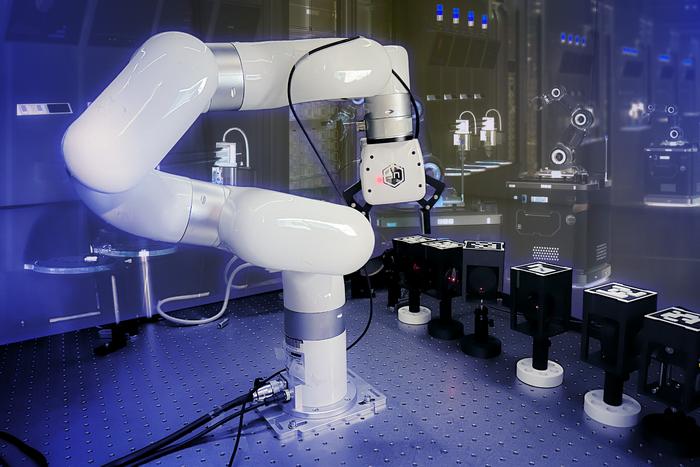
According to MIT, the system centers on a seven-joint robotic arm mounted beside a metal optical table. Each lens, mirror or other component is placed inside a 3D-printed housing carrying a QR code that identifies the component and its properties. Magnetic bases hold the components in place after the robot positions them.
For fine adjustments, the researchers developed a Wi-Fi-enabled motorized tool that turns standard optical-mount controls, while two overhead cameras and software help the robot identify, grasp, place and avoid colliding with components.
In the laser-cavity test, the robot positioned two mirrors around a crystal and aligned them precisely enough to produce a functioning laser. The system can also center and align beams and automatically readjust components when vibrations or temperature changes disturb the setup.
“Even tiny vibrations or temperature changes can degrade an optics experiment,” said Sachin Vaidya, a postdoc in MIT’s Research Laboratory of Electronics. “An autonomous lab could continuously monitor its own performance and repair the alignment before valuable data is lost.”
What’s Next?
The work is still focused on a tabletop prototype rather than a fully autonomous laboratory. The MIT team said it is working to improve the robot’s sensing, maneuvering capabilities and available workspace while developing a cloud-based interface that would let researchers remotely submit experimental setups.
The researchers envision future laboratories where robots could retrieve components from nearby storage, build experiments, run them continuously, dismantle them and configure new experiments on demand. Such systems could also allow experiments requiring round-the-clock monitoring to operate with less manual intervention.
“There are many things this could enable,” says Marin Soljacic, the Cecil and Ida Green Professor of Physics at MIT. “Arobot isn’t going to get bored. It can work 365 days, 24 hours a day, on very boring things. That will free up so much creativity and time for scientists to then push theories and see what we can do. Science could progress much faster.”
The team is already applying the robotic laboratory to experiments involving carbon-capture materials, using controlled light to study how candidate materials absorb carbon dioxide.
“A system like this could help industry test prototypes faster, for everything from cameras and displays to solar cells and AR/VR goggles,” Vaidya said .“Experimental optics is the backbone of many important fields. Our work takes the first step toward optical labs that can operate faster, more reliably, and without manual intervention in a domain that demands extreme precision and diversity of experimental setups.”
The Team & Support
The project team included researchers from MIT, Nokia Bell Labs and Arizona State University. The research was supported in part by the Korea Foundation for Advanced Studies Overseas PhD Scholarship, the U.S. National Science Foundation, the U.S. Army DEVCOM ARL Army Research Office, Parviz Tayebati, the MIT Undergraduate Research Opportunities Program, the MIT Generative AI Impact Consortium and Shell International Exploration and Production Inc.
The MIT team is scheduled to present the system at the Intelligent Robots and Systems conference.
Featured image credit: Sachin Vaidya, Marin Soljacic