
Insider Brief
- Light Origins launched Light-O1, its first general-purpose embodied foundation model, using human actions recovered from internet video to create a reusable starting point for adapting robots to different tasks and embodiments.
- The company trained six 4-billion-parameter versions on up to 120 billion multimodal tokens, with larger pretraining runs reducing held-out next-action and whole-body pose prediction errors across human, Unitree G1 and LightBot datasets.
- Light Origins also released Light-O1-Preview and said its broader physical AI roadmap includes LightNav-0 for alignment and Light REACT for adapting robot behavior to recent physical interactions.
Light Origins announced the launch Light-O1, its first general-purpose embodied foundation model, using human actions recovered from internet video to give robots a reusable starting point for learning different tasks.
The China-based company, which raised a Pre-A round of several hundred million yuan in August 2026, reported that it trained six versions of the same 4-billion-parameter base model using between 3.75 billion and 120 billion multimodal tokens. The largest run represented about 100,000 hours of human action. Each version was then adapted separately to public first-person human data, public Unitree G1 robot data and data from Light Origins’ own LightBot humanoid.
Across all three datasets, prediction errors declined as pretraining increased, according to Light Origins. The company said the results followed power-law trends and that larger-scale human-action pretraining provided a stronger starting point for downstream adaptation.
Light Origins stressed that the reported robot results still use target-specific data and the scaling tests measured held-out next-action and whole-body pose prediction rather than real-world task-success rates.
Light Origins also released Light-O1-Preview, a text-to-action model that accepts a natural-language instruction, describes the required body movement and generates a corresponding whole-body action sequence. Model weights, code and a public playground are available with the release.
Learning From Human Video
Instead of depending entirely on robot-generated data, Light Origins extracts structured 3D human actions from internet videos and aligns them with visual information and language. The model learns recurring patterns of physical behavior before being adapted to robots.
In demonstrations, Light-O1 performed several tasks:
- LightBot opened a shoe cabinet and placed slippers inside.
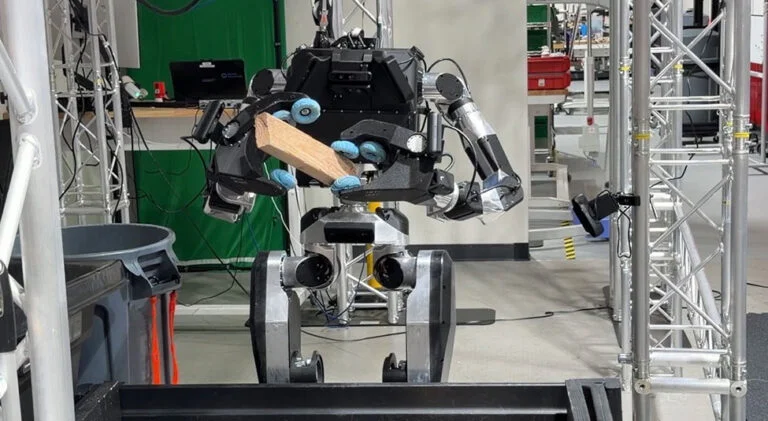
- The humanoid picked up different types of trash, including when items were moved during the task.
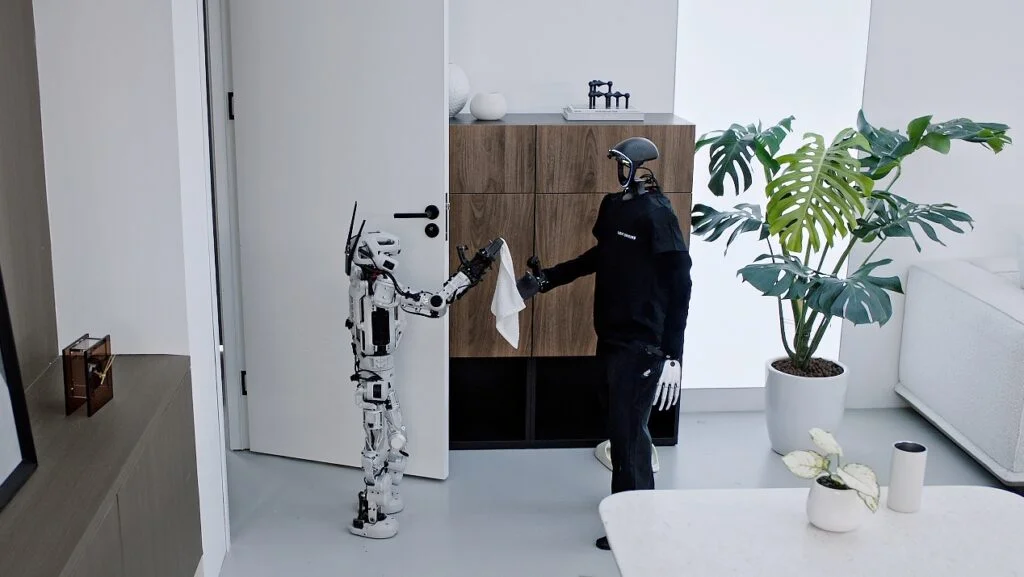
- LightBot performed a towel handoff.
- A Unitree G1 wiped a table and received the towel during the same demonstration.
The company said its data infrastructure now operates at the thousand-GPU scale and processes about 200,000 hours of video each week, up from 12,500 hours six months ago.
A Physical AI Roadmap
Light Origins organizes its development around the three areas of scalable pretraining, alignment and deployment, with Light-O1 representing the pretraining stage.
Earlier this month, the company introduced LightNav-0 for alignment. Its Real2Sim2Real system converted more than 2,000 internet-sourced scenes into simulated environments, producing more than 4,000 hours of navigation experience, according to Light Origins. The resulting model generalizes across humanoid, quadruped, aerial and wheeled robots without additional training.
For deployment, Light Origins uses Light REACT, a system designed to help robots adjust their behavior based on recent physical interactions. It uses that context to estimate outside forces, hardware impairments and environmental constraints before adapting whole-body movements.