XPeng Introduces GroundingPI, an Open-Source Visual Perception Model for Physical AI
 By Greg Bock · · 5 min read
Insider Brief
- XPeng researchers and academic partners have introduced GroundingPI, an open-source visual perception model for physical AI that they claim outperformed GPT-6 Astra on specialized perception benchmarks and showed potential to improve robot training efficiency.
- The 4-billion-parameter model achieved an aggregate score of 73.68 across 34 visual perception benchmarks, compared with 71.54 for GPT-6 Astra, although the results do not establish broader superiority in general AI capabilities.
- In simulated robot manipulation tests, GroundingPI achieved a 28.75% task success rate using half the available demonstrations, compared with 27.75% for the strongest competing model using 75%, suggesting that improved visual perception could reduce training data requirements.
Researchers affiliated with Chinese smart EV maker XPeng and several universities have developed an open-source AI model that they claim outperformed GPT-6 Astra on a series of visual perception benchmarks, with additional experiments suggesting it could help robots learn physical tasks using less training data.
The model, called GroundingPI, achieved an aggregate score of 73.68 across 34 perception benchmarks, compared with 71.54 for GPT-6 Astra, according to the research paper. The evaluation covered 11 categories of visual perception and included 44 comparison models.
Developed by researchers affiliated with XPeng, Peking University, the University of Hong Kong and other institutions, GroundingPI focuses on helping AI systems identify objects and understand their precise locations and spatial relationships.
According to XPeng, the 4-billion-parameter model as a potential foundation for physical AI applications, including robotics and autonomous driving. The company also made the research paper, model weights and supporting code publicly available.
The benchmark results are specific to visual perception and do not establish that GroundingPI is more capable than GPT-6 Astra in general reasoning or other AI tasks. The researchers also reported that Astra performed better on several individual tests.
Teaching AI to Understand What It Sees
Unlike models designed primarily for general reasoning and planning, GroundingPI concentrates on the visual understanding needed to support physical interaction.
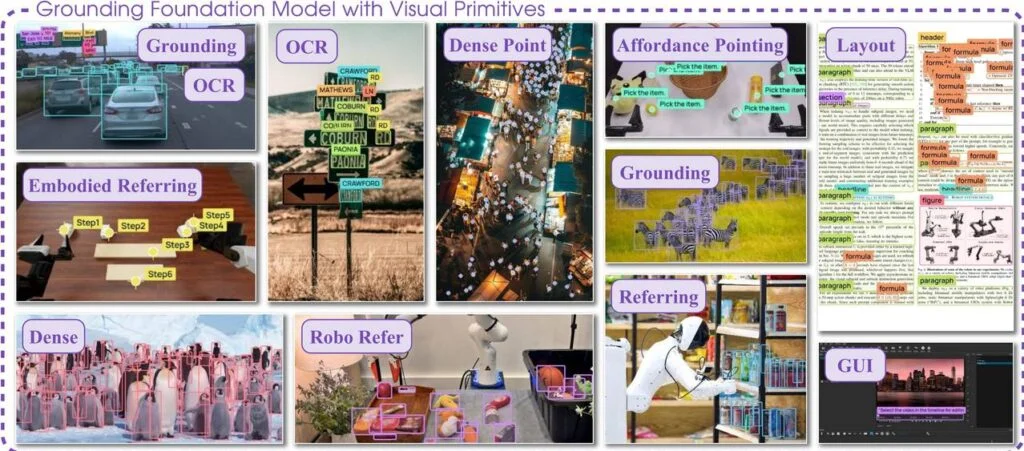
GroundingPI focuses on visual grounding, which connects objects described in language with their locations in an image. For example, when asked to identify the handle of the cup on the right, an AI system must recognize the correct cup and pinpoint its handle. GroundingPI represents locations using coordinates, including points and boxes that mark specific areas of an image.
The researchers trained the model without using robot action labels, separating the development of visual perception from the training needed to control physical movements.
Its training covers 11 categories of visual perception, including capabilities such as:
- Object detection and localization: Recognizing objects and identifying their positions, including small objects in crowded scenes.
- Language-based visual grounding: Locating objects or parts of objects based on written descriptions.
- Text recognition: Reading text in images and understanding document layouts.
- Interface recognition: Identifying elements within digital user interfaces.
- Robotic spatial localization: Determining object positions relevant to robotic operations.
The research paper reports particularly strong results on tasks involving densely packed objects. On the Dense200 benchmark, GroundingPI scored 74.53, compared with Astra’s 65.04.
The advantage was not consistent across every category. Astra scored 93.17 on ScreenSpot-Pro, a benchmark for identifying elements in computer interfaces, compared with GroundingPI’s 65.78.
The researchers calculated their overall score by giving equal weight to the 11 perception categories, rather than averaging all individual benchmark results together. The paper also notes that differences in how some models handle prompts and produce responses can affect comparisons.
Improving Robot Training Efficiency
Beyond visual benchmarks, the research team tested whether GroundingPI could improve robot manipulation when used as the visual component of systems that learn physical movements.
One finding involved training efficiency. In RoboCasa-GR1 simulations, GroundingPI achieved a 28.75% task success rate using half the available robot demonstrations. The strongest comparison model, RynnBrain, achieved 27.75% using 75% of the demonstrations.
The researchers suggest that stronger visual perception could reduce the amount of task-specific training data needed to develop certain robotic skills. However, the success rates also show that the systems struggled to complete many of the simulated tasks.
The paper reported additional findings across robotic manipulation and autonomous driving tests:
- Robot manipulation: GroundingPI achieved a 66.20% task success rate on RoboTwin 2.0 and 37.75% on RoboCasa-GR1 using the full training datasets. RynnBrain performed slightly better on the latter benchmark, scoring 39%.
- Adaptability: GroundingPI ranked first among the evaluated models across four tests involving unfamiliar environments or objects. In one RoboTwin 2.0 test involving changed environmental conditions, it achieved 17.60% success, compared with 14.10% for the next-best model.
- Autonomous driving: Using the nuScenes dataset, GroundingPI achieved an average trajectory prediction error of 0.296 meters, compared with 0.301 meters for Qwen3-VL-4B and 0.308 meters for RynnBrain.
The manipulation experiments used two different robotic setups. RoboTwin 2.0 evaluated two-armed robots performing tabletop tasks, while RoboCasa-GR1 tested more detailed manipulation involving humanoid robotic hands.
To compare the visual models, the researchers kept the robot control architecture, action-training data and training procedures consistent within each benchmark while changing the underlying visual model.
GroundingPI ranked first in five of six manipulation evaluations, including all four tests measuring performance under unfamiliar conditions.
The autonomous driving tests produced a smaller improvement. Researchers evaluated how accurately the model predicted vehicle movement using recorded information rather than measuring its performance in live traffic.
Research Limitations and Next Steps
The findings remain limited to simulations and offline evaluations. The paper does not establish whether GroundingPI would produce comparable improvements in robots operating in factories, warehouses or other real-world settings.
The researchers also identified areas where the model still struggles, including locating very small objects, identifying precise object boundaries, recognizing some forms of text and interpreting computer interfaces.
Although the robot manipulation experiments used consistent downstream training procedures, the comparison models differed in architecture, size and earlier training, according to the paper.
The researchers are exploring an approach in which specialized visual perception models work alongside larger AI systems responsible for reasoning and planning. GroundingPI would provide information about objects and their locations, while other systems would determine what actions to take.
That combined approach remains a research direction rather than a demonstrated real-time robotic control system.
In its announcement, XPeng described GroundingPI as an academic research contribution supported by the company and its collaborators. The automaker has not announced plans to integrate the model into its commercial vehicles, humanoid robots or other products.
The research is available as an arXiv preprint, with the model weights and supporting code released for further study under applicable licensing terms. The research paper, source code and model weights are publicly availa