Switzerland’s Embodied AI Unveils Humanoid Robot Designed to Learn Factory Tasks From Workers
 By Greg Bock · · 3 min read
Insider Brief
- Swiss robotics startup Embodied AI has introduced Air, a wheeled humanoid robot designed to work alongside factory employees and learn manual tasks through human demonstrations, with testing underway at major manufacturers.
- Air uses lightweight, tendon-driven arms designed to yield on contact, while its AI software learns from human-operated tasks and typically transitions to autonomous operation within about a month, according to the company.
- Embodied AI is preparing for larger-scale production, with CE marking planned for 2027, while its existing two-armed industrial robot system achieved 98% reliability in a separate factory cable-handling evaluation.
Swiss robotics startup Embodied AI has introduced Air, a wheeled humanoid robot designed to work alongside factory employees and learn manual tasks through human demonstrations, with testing already underway at major manufacturers.
The company announced it is unveiling Air on Nov. 6 at Humanoid Europe 2026 in Munich, nine months after beginning development. Embodied AI said it has signed contracts with major manufacturers globally and is preparing for larger-scale production.
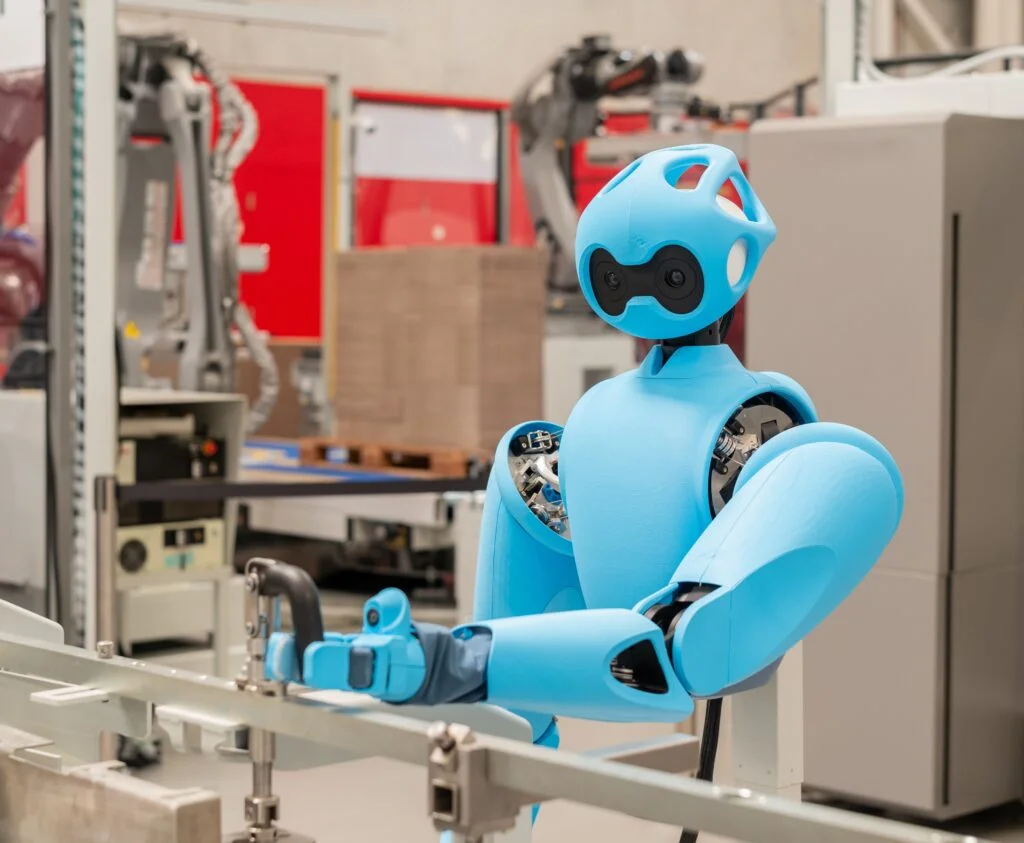
Air is designed to handle repetitive tasks requiring precise hand movements that frequently change, making them difficult to automate with conventional industrial robots. Rather than using traditional robotic arms built for heavy industrial work, Embodied AI developed a lightweight, tendon-driven system intended to reduce the risk of injury when robots come into contact with people.
The robot’s motors, gearboxes and electronics are housed in its torso, with tendons controlling its lightweight arms. According to the company, the design allows the arms to yield when they encounter an obstruction or make contact with a person. Also, Air moves on wheels rather than legs, which Embodied AI said provides greater stability on flat factory floors.
The company noted Air was designed under ISO/TS 15066:2016, a technical specification addressing collaborative industrial robot safety, with CE marking planned for 2027.
Learning Through Human Demonstrations
The company indicated it is focused on manufacturers looking to automate manual work while keeping employees involved in tasks requiring human expertise. Air initially performs jobs under human control, recording the activities so the company’s AI software can learn the movements and eventually perform them independently.
According to Embodied AI, the transition typically takes about a month, depending on the task. Human operators remain available to handle unfamiliar situations, while skills learned by one robot can be transferred to others.
The company said its AI software is already being used in paid factory deployments involving a separate two-armed industrial robot system.
In one evaluation conducted by a major consumer electronics manufacturer, Embodied AI reported achieving 98% reliability on a cable-handling task, exceeding the customer’s 90% target. The company said four other startups participating in the evaluation failed to meet the manufacturer’s requirements.
Co-founder and CEO Francesco Stella said safety and reliability were central to Air’s development because errors made by robots performing physical tasks can cause damage or injuries.
“Hallucination of AI models is acceptable in the digital space because humans review, reject, or correct the output before acting on it,” Stella said. “In robotics, however, incorrect actions have immediate and irreversible physical consequences. When AI is used to taking physical actions, errors can cause severe damage or endanger human lives. Safety and reliability are non-negotiable requirements of physical AI to enter the real world at scale. These are the principles that guided the design of Air.”
Air’s tendon-driven arm design grew out of Stella’s doctoral research at EPFL, the Swiss Federal Institute of Technology in Lausanne. He previously conducted research at MIT’s Computer Science and Artificial Intelligence Laboratory. Stella co-founded Embodied AI with chief technology officer Kai Junge and chief operating officer Max Polzin, both of whom have doctoral backgrounds in robotics.
The company is backed by Faber, which led its first funding round, along with TechShop, Look AI Ventures, Plug and Play and Vento.