Odyssey has introduced Odyssey-3, a foundation world model designed to control robots, humanoids, autonomous vehicles and drones using the same underlying AI system.
According to the company, Odyssey-3 is an autoregressive diffusion transformer trained on a wide collection of visual observations of the physical world. Rather than training a separate foundation model for each machine or task, Odyssey is using the model as a common base that can be adapted with relatively small amounts of task-specific data.
Odyssey said the model has learned representations of physics, motion, cause and effect and human behavior through pretraining. Developers can then attach an action decoder, a component trained to translate those representations into commands for a particular robot or other system.
Odyssey-3 Powers Humanoid Control With Flexion
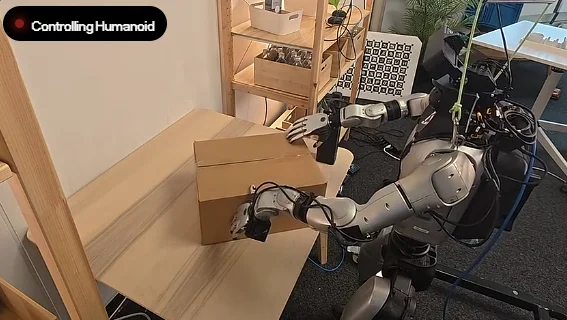
Odyssey said it is testing whether world-model pretraining can reduce the amount of robot-specific data needed to teach humanoids new skills in a research collaboration with Flexion, which specializes in reinforcement learning and whole-body control.
Using only tens of hours of humanoid teleoperation data, Flexion built control policies on top of Odyssey-3 for tasks including opening containers, moving objects and placing items in specific locations. Odyssey said the resulting system generalized better than the VLA baselines it tested, continuing to perform under lighting changes that caused those models to fail.
“What excites us about Odyssey-3 is the opportunity to build on physical knowledge acquired far beyond a robot’s own demonstrations,” Flexion co-founder and CEO Nikita Rudin said. “Combining that foundation with our research in humanoid learning and control opens up exciting possibilities for how quickly robots can acquire useful skills and adapt to unfamiliar situations.”
Robot Arms, Driving & More
Beyond humanoid robots, the company also demonstrated Odyssey-3 across several types of physical and virtual systems:
- Robot arms: Odyssey said tens of hours of demonstrations were enough to train systems for tasks including pouring, cleaning and moving objects, with some recovery behaviors appearing even when they were not included in the demonstrations.
- Driving: A policy trained with 20 hours of simulated driving data was used to generate driving trajectories in real time. Odyssey said simulation-trained policies traveled about 77% as far between safety-driver interventions as policies trained using real driving footage.
- Drones: Tens of hours of simulated flight data were used to train an indoor navigation policy that avoided obstacles and generated flight waypoints.
- Video games: Odyssey also trained policies to play games including Grand Theft Auto V, with early examples of behaviors transferring to Red Dead Redemption 2 and Sleeping Dogs without additional policy training on those titles.
Odyssey said it is also working with robotics benchmarking company Poke & Wiggle to test how well the model transfers across different robot bodies, viewpoints and control systems.
The company was founded in 2023 by Oliver Cameron and Jeff Hawke around the idea that world models could provide a common foundation for physical intelligence. Odyssey said it plans to release Odyssey-3 publicly in the coming weeks.
Featured image credit: Odyssey